How to Spot a Client About to Quit (Before They Ghost You)
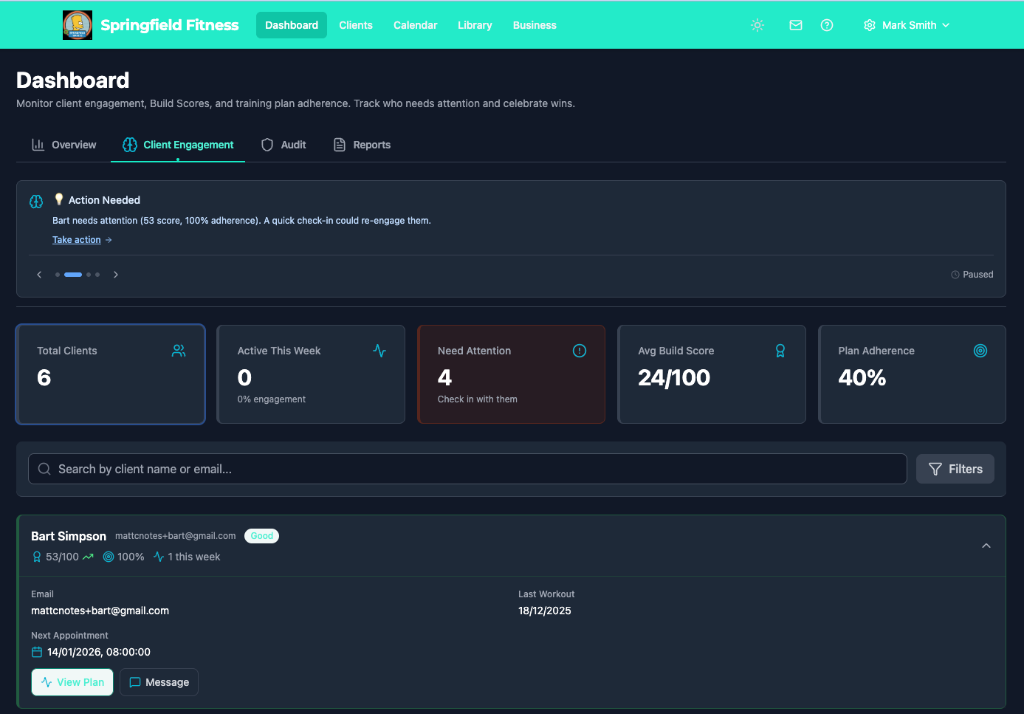
Most clients don't quit overnight — there's a 30-day window between first signs of disengagement and cancellation. Engagement scoring catches dropping session frequency, rising cancellations, and declining effort before you lose the client.
The text goes unanswered
You sent the check-in on Monday. Nothing. A follow-up on Wednesday. Read receipts on, no reply. Then the email arrives on Friday: "Hey, I need to put my sessions on hold for a bit."
Every trainer has been here. The client did not leave suddenly. They left slowly, over weeks, and by the time you noticed, the decision was already made.
The question is not whether this will happen. It will. The question is whether you can spot it 30 days earlier.
Five signals your client is pulling away
These are the patterns that show up before the cancellation email. None of them is proof on its own. Two or three together, and you have a problem.
1. Session frequency drops
A client who trained three times a week is now booking twice. Then once. This does not always mean they are leaving. Life gets busy. But if the drop lasts more than two weeks with no explanation, something has changed.
What to do: Ask directly. Not "are you okay?" but something specific. "I noticed you've gone from three sessions to one over the past couple of weeks. Is something going on with your schedule, or do we need to adjust your program?" Specificity shows you are paying attention.
2. Late cancellations increase
Everyone cancels a session occasionally. But a pattern of same-day cancellations, especially when they do not rebook, is a strong signal. The client is still paying but has stopped prioritising their sessions.
What to do: Look at the last four weeks. If cancellations are trending up, reach out with a program adjustment. "I was thinking about your goals and wondering if a different session structure might work better for your schedule right now." Give them a reason to re-engage, not a guilt trip.
3. In-session effort declines
RPE (Rate of Perceived Exertion) tells you how hard a client feels they worked. If a client who consistently reported RPE 7-8 starts coming in at 5-6 with no program change, their motivation has shifted. They are showing up because they feel obligated, not because they want to be there.
What to do: Adjust the program. Add variety. Change the stimulus. Sometimes a client who has been doing the same split for 12 weeks needs something different. Ask them what they have enjoyed most and build from there.
4. Communication goes quiet
The client used to reply to messages within an hour. Now it takes a day. They stopped asking questions about their program. They do not comment on progress updates. Silence from a previously engaged client is louder than any complaint.
What to do: Send something useful, not a "just checking in." Share a specific observation: "Your squat form last week was the best I've seen. Here is what I want to build on next session." Give them a reason to respond.
5. They stop using the app
If your software shows client activity, check it. A client who used to log workouts, check their schedule, and review their program but has gone quiet in the app is disengaging from the service, not just from you.
What to do: This is the hardest signal to act on because most PT software does not surface it. You would need to manually check each client's last login, last booking, and last program view. With 20 clients, that is not realistic. Daily habit tracking gives you an earlier, more frequent signal than session or app activity alone: a client who stops completing a two-minute daily habit is telling you something a week before their next missed session does.
Why trainers miss these signals
You are coaching 15 to 25 clients. Each has their own schedule, goals, injuries, and communication patterns. Mentally tracking engagement across all of them is not a skill problem. It is a bandwidth problem.
Your current software stores the data that would flag these patterns. Session frequency. Cancellation rates. App activity. Revenue per client. But it does not connect the dots. It does not tell you that Sarah's engagement dropped 40% this month. It waits for you to notice, and by the time you do, she has already decided to leave.
What engagement scoring changes
BuildStability assigns every client a score from 0 to 100, updated automatically based on session attendance, booking patterns, cancellations, app activity, and trainer interactions. When a client's score drops below a threshold, you get flagged.
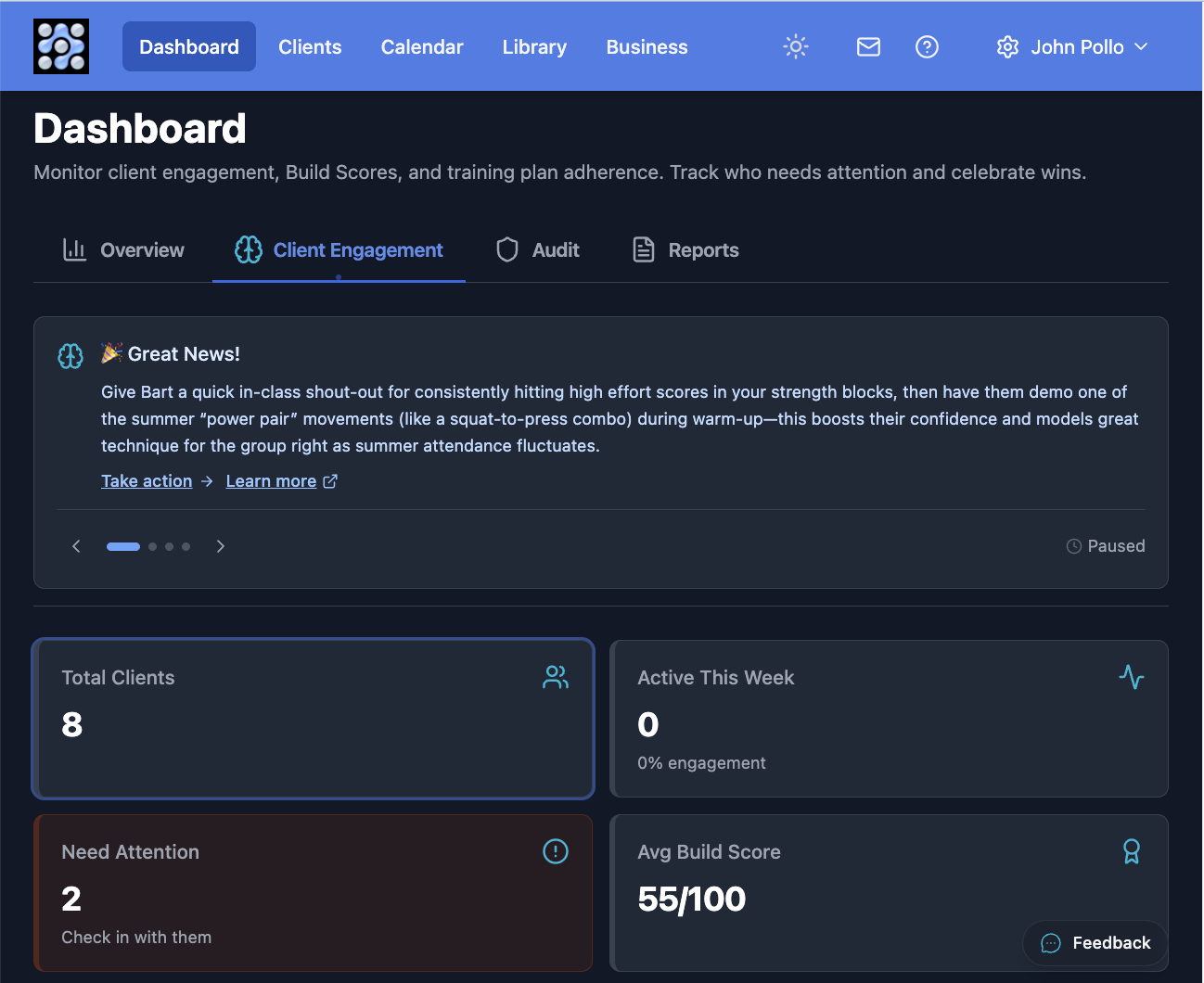
You do not have to check a dashboard. You do not have to build a spreadsheet. You open the app, and the AI tells you: "Two clients at risk this week. Sarah's engagement is at 42 and dropping. Mark has not booked in 14 days."
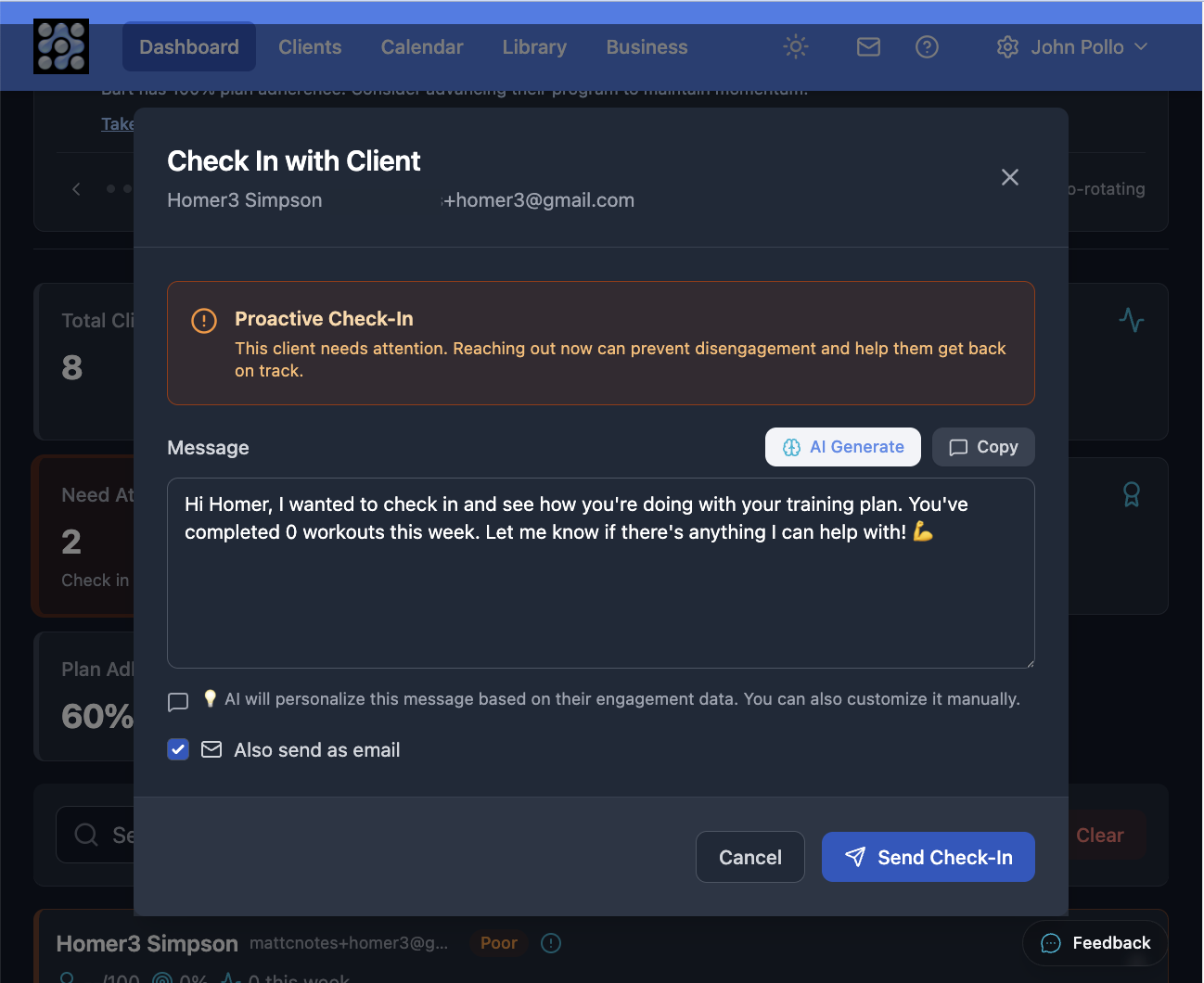
You can then ask the AI to draft a check-in message for each. Review it, adjust the tone, and send. Total time: two minutes. The alternative is not noticing until the cancellation email arrives.
The 30-day window
Most clients do not quit overnight. There is a window, usually 30 days, between the first signs of disengagement and the cancellation. That window is where retention happens.
If you catch the drop at day 5, you can adjust the program, change the session structure, or have a direct conversation. By day 25, the client has already made their decision. You are not saving them. You are processing their exit.
The difference between losing a client and keeping one is knowing 30 days early. That is what your software should do. Not because the technology is impressive. Because the data was already there.
BuildStability flags at-risk clients on every plan, starting at $19 AUD/month (plus standard Stripe processing fees on client payments). See how it works or start a free trial. Pricing current as of September 2026.
Frequently Asked Questions
How do I know if a personal training client is about to cancel?
Five warning signs: session frequency drops from three times to once per week, late cancellations increase without rebooking, in-session RPE effort declines from 7-8 to 5-6, communication goes quiet (slow replies, no questions), and app/platform usage stops. Two or three of these together over 2-3 weeks is a strong signal.
What is engagement scoring for personal trainers?
Engagement scoring assigns every client a score from 0 to 100 based on session attendance, booking patterns, cancellations, app activity, and trainer interactions. When a score drops below a threshold, the trainer gets flagged. It replaces the mental tracking that becomes unreliable beyond 15-20 clients.
How far in advance can you predict client churn?
Most clients show disengagement signals 30 days before cancelling. The window between the first attendance drop and the cancellation email is where retention happens. Catching the drop at day 5 gives you time to adjust programs and have a direct conversation. By day 25, the decision is already made.
What is the average client retention rate for personal trainers?
Personal training studios average 80% annual retention compared to 66% for traditional gyms (Association of Fitness Studios). Most PT clients stay 3-6 months on average. Nearly 50% of new fitness clients drop off within the first 90 days when onboarding is weak (Trainero, 2026 — industry platform survey). Boosting retention by just 5% can increase profits by 25-95% (Bain & Company / Harvard Business School), and acquiring a new client typically costs several times more than retaining one.
How do personal trainers improve client retention?
Members visiting 2+ times per week are 50% less likely to cancel than those attending once (IHRSA, 2020). Track engagement data instead of relying on memory. Follow up within hours of a no-show. An industry education survey found that many clients who achieved their goals left because no follow-up plan was offered (PTDC, industry education platform). Automated engagement scoring flags at-risk clients so you can act in the 30-day window before cancellation.
Ready to automate your training business?
Start your 14-day free trial. No credit card required.
Start Free Trial