Can I build my coaching app with ChatGPT in 2026?
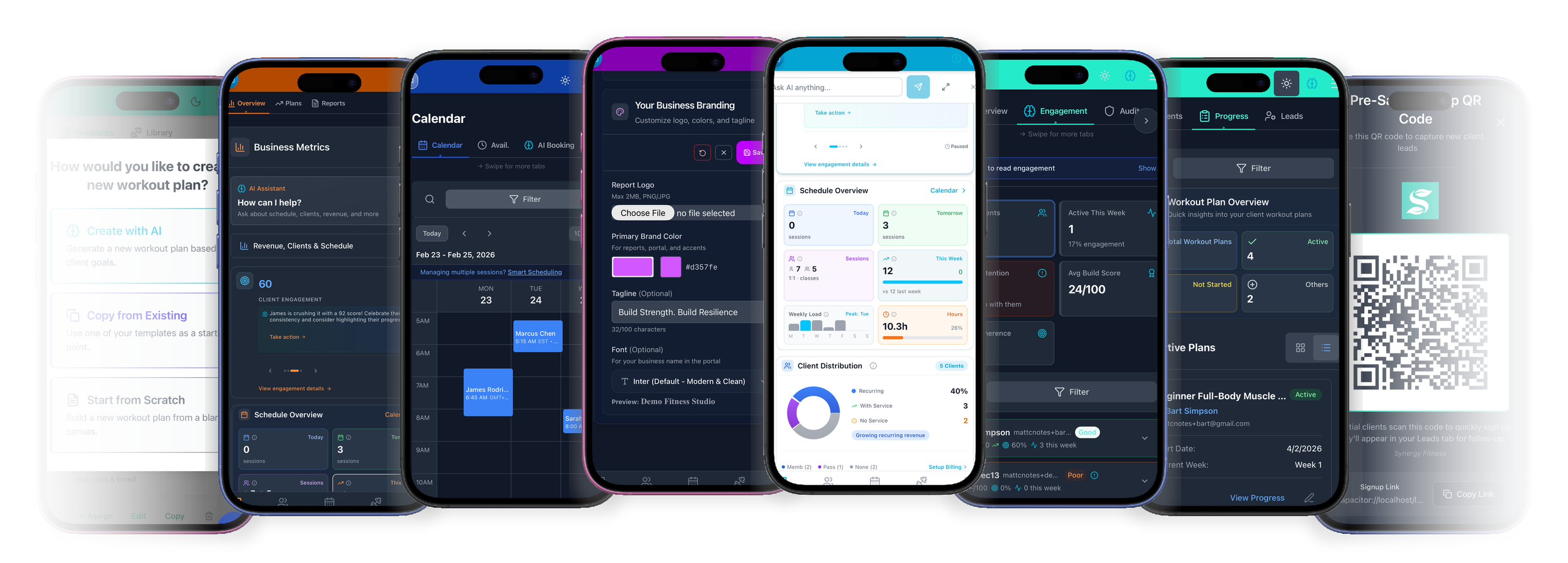
ChatGPT can prototype a coaching app in a weekend, but Apple's rules will not let you publish one to the App Store. There are three real ways to get your brand on a fitness app in 2026. Most of what trainers see on Instagram is the hype. Here is what is actually working.
Three reels, three pitches, one question
Open Instagram in 2026 and three different reels keep landing in your feed. A free-tracker app pitched as "stop paying for software." An offshore agency offering to build your fitness app for a price they will not put on the post. And a physio holding up an AI-built running app for his kid: "holy smokes, this might break the fitness app industry." Three pitches, three versions of the same question. Should I be paying for fitness software at all in 2026?
Short answer: yes, you can build a working app over a weekend with ChatGPT. A working app your clients are still paying through in 12 months, that survives an iOS update, that you can support without becoming a part-time developer? Different question. That gap is what this post is about.
There are three real ways to put your brand on a fitness app. The cost gap between them is bigger than most trainers expect:
- Custom-built app. You build it (DIY with ChatGPT, or hire an agency) and own the code. Cheapest in cash if you DIY, most expensive if you hire. Yours forever, headaches included.
- White-label app. A software vendor publishes a separate app on the App Store under your business name and maintains it for you. The catch: the listing comes from your Apple developer account in your business name, and you carry the App Store rejection risk.
- Branded client portal. Your clients open the vendor's app and see your logo, colours, and business name on every screen they use. The icon on their phone is the vendor's. Everything they touch is yours. No Apple developer account needed.
The rest of this post is what each of those actually costs in Australia in 2026, and where the AI-built story falls apart for a working PT.
How much does a custom-built fitness app cost?
DIY with ChatGPT runs around A$1,400 in cash for year one (Apple and Google developer fees, hosting, email, ChatGPT subscription, domain), but the time cost is yours and the App Store outcome is uncertain. An offshore freelancer builds a template re-skin for around A$10,000 to A$15,000, often web-only, often rejected by Apple. An Australian agency building a genuine native iOS and Android coaching app with payments, scheduling, programming, and a workout logger sits at A$60,000 to A$130,000. A boutique agency with video, AI features and the bells lands closer to A$150,000. Above that is enterprise scope a working PT does not need.
Then the yearly bill kicks in. A working maintenance budget for an agency-built fitness app is A$20,000 to A$30,000 a year. That covers Apple and Google developer fees, hosting, security patches, the iPhone software update every September that breaks something, the App Store policy change that arrives without notice, and the real-world bugs. New features come on top. DIY this yourself and the cash drops to A$200 to A$6,000 a year, but the time cost is 80 to 140 hours at steady-state (and 140-260 hours in year one to ship and stabilise), which is A$8,000-A$14,000 a year in coaching revenue you are not earning.
So can I build my own coaching app with ChatGPT?
Quick credibility note. I have spent 25 years building financial software for Australian businesses. The kind where a leak, outage, or botched compliance flow costs someone real money. I use the same AI tools the coach-bro reels are using, every day. The difference is what I use them for, and what I have learned not to trust them with.
So this is not "AI is overhyped" from someone who has not tried it. AI tools are real and they have changed how serious software gets built in 2026. The narrower question worth asking: can a non-technical person use them to ship a consumer iPhone app to paying clients? Different question, different answer.
A weekend-built app works on the day you build it. The reels show you that day. What they skip is the Tuesday night six months later when the app goes down at 6pm and 12 of your evening clients cannot log their workouts. The email from a client asking "why can my mate see my progress photos?" The iPhone update last September that broke push notifications and three clients quietly drifted off.
Here is what AI tools do not change:
- Keeping client data safe. Progress photos, injury notes, payment details. If the app leaks, your name is on it, not ChatGPT's. Australian privacy law puts the obligation on the trainer. Building this the way a working SaaS company does it takes months, not days.
- Health data legal exposure. A botched data deletion request, a leaked injury history, a poorly-designed consent flow can each become a regulator letter. Your indemnity insurance does not necessarily cover software you built yourself.
- The maintenance treadmill. Apple ships a new iPhone software version every September. Android does the same in August. Each release breaks something. AI tools will not keep your app working while you are coaching 20 clients a week.
The reality from inside the industry: AI tools cut build time roughly in half for a developer. They take a non-developer from "impossible" to "really hard". They do not cut the hosting bills, the security work, the legal exposure on health and payment data, or the maintenance that follows every shipped app.
For a busy PT, "I will build and maintain my own app" sits in the same drawer as "I will do my own tax return." Technically possible. The hours, and the risk, have to come from somewhere.
If you do go down the ChatGPT-build path, at minimum get the security and payment flow reviewed by someone with commercial developer experience before any paying client touches the app. ChatGPT writes confident code that looks correct and quietly does the wrong thing. You do not know what you do not know, and a regulator letter or a leaked progress photo is a much harder problem than a A$300 review fee.
How much does a white-label fitness app cost?
White-label is the option a lot of trainers consider before going custom-built. The model:
- A software vendor (My PT Hub, Trainerize Studio Plus, Mindbody) helps you publish a separate app on the App Store and Google Play under your business name.
- You add your logo, your colours, your business name, and your contact details.
- The infrastructure, the exercise library, the wearable connections, the payment processing are all already built. The vendor maintains them.
- Your client searches your business name in the App Store, finds your app, downloads it, and uses it.
The trade-off, in My PT Hub's own words, is that you do not have complete control over the feature roadmap. New features get added across the whole product on the vendor's schedule, not yours. For most trainers that is fine, because the features they actually need are already there and new ones get added regularly without any extra cost to you.
What is less advertised on the marketing pages, and worth knowing before you sign up:
You still need your own Apple developer account
The vendor builds the app, but the App Store listing has to be published from a developer account in your business name. Both My PT Hub and Trainerize confirm this in their own help docs.
- Apple Developer Program: around A$145 a year, paid by you, direct to Apple. Forget to renew and your app vanishes from the App Store the same day.
- My PT Hub specifically requires you to enrol as an organisation with Apple, not as an individual. That requires a D-U-N-S number for your business (free to request, takes 1 to 2 weeks), a privacy policy hosted on your own website, and your own website to actually exist.
- Trainerize requires the same Apple Developer Program enrolment in your business name.
That is your account, your renewal, your responsibility. The vendor's help is around the technical submission. The legal account holder is you.
Apple's review is your problem, not the vendor's
The vendor builds the app. You submit it. That means uploading screenshots, writing the App Store description, replying to Apple's review questions, and re-submitting if Apple rejects it (which happens, and Apple has specific rules against "template" apps that vendors like My PT Hub and Trainerize work inside). My PT Hub's own page calls it a 4 to 6 week launch.
Two questions worth asking any white-label vendor before you sign: when Apple rejects my app, who fixes it and what does it cost? And how do iPhone software updates flow into my listing each September? If the vendor cannot answer concretely, that is the signal.
What the white-label apps actually cost in 2026
Pricing varies and most vendors do not publish their white-label price publicly:
- My PT Hub Custom Branded App (basic, single one-off branding): US$95 one-off (around A$140), available on Starter and up. Verified from My PT Hub's pricing page schema, last modified 24 April 2026.
- My PT Hub White Label app (full white-label with App Store listing under your name): price is not published on My PT Hub's pricing page. Available on Premium subscription on top of your normal sub. Quoted privately. Industry chatter and trainer reports put it in the A$300+ a month range, but you will need to ask My PT Hub directly.
- Trainerize Studio Plus at US$248 a month per location (around A$370 at current FX rates, May 2026) includes a branded iPhone, Android, and Apple Watch app. Pro 5 tier offers a one-off branded app for US$169 setup.
- Mindbody does not publish branded-app pricing. Third-party reviews (G2, Pabau) report it bundled into the Ultimate Plus tier at around US$599 a month, or sold as an add-on at around US$199 a month on lower tiers. Mindbody confirms pricing only on a sales call.
For a multi-trainer studio with a marketing budget targeting App Store discovery, white-label can be the right answer. For a solo PT working 20 to 50 clients, the maths gets harder once you include your own Apple developer fee, the launch time, the ongoing review risk, and the gap between the app you wanted and the app you actually shipped.
What does a branded client portal include?
This is the model BuildStability uses, and the one most solo PTs and small studios end up choosing once they see the price gap.
- The software vendor publishes one app on the App Store and Google Play, under their own name.
- Your clients download that app once. Your business sits inside it.
- When your client logs in, every screen they touch shows your logo, your business name, your brand colours.
- The icon on the home screen of your client's phone is the vendor's. Every screen after the first tap is yours.
- All the maintenance, App Store updates, policy compliance, server costs are the vendor's problem.
The trade-off is the App Store icon. Your client sees the vendor's name on their home screen, not yours. After the first tap, they see your business everywhere.
For a solo PT or small studio that almost never matters. Your client got the link from you, downloaded the app you sent them, and is not browsing the App Store for "personal training app" looking for you. They are using your software because they signed up with you, not because they found the listing.
For a multi-trainer studio that markets through paid App Store install ads or App Store search, the listing under your name matters more.
What the numbers actually look like over five years
Subscription options (no big upfront, vendor handles maintenance):
| Option | First-year bill | 5-year total | Best for |
|---|---|---|---|
| Branded portal at A$30/mo (entry-tier vendor) | A$360 | A$1,800 | Solo PTs, under 25 clients |
| Branded portal at A$90/mo (mid-tier vendor) | A$1,080 | A$5,400 | Solo PTs, 25-100 clients |
| Branded portal at A$200/mo (vendor that gates branding to higher tiers) | A$2,400 | A$12,000 | If branding is gated and you need it |
| Trainerize Studio Plus (~A$370/mo, includes white-label app) | A$4,440 | A$22,200 | Multi-trainer studios that want App Store presence |
Custom-built (you fund the build, you fund the maintenance):
| Option | Upfront | First-year bill | Your time | Year 5 real cost |
|---|---|---|---|---|
| DIY with ChatGPT | ~A$0 | ~A$1,400 | 140-260 hrs year one, 80-140 hrs/yr after | ~A$72,000 |
| Offshore template build | ~A$10,000 | ~A$25,000 | low | ~A$110,000 |
| Mid-range custom build (AU agency) | ~A$80,000 | ~A$105,000 | low | ~A$200,000 |
| High-end custom build (boutique agency) | ~A$150,000 | ~A$175,000 | low | ~A$270,000 |
The Year 5 real cost includes both cash and the opportunity cost of your own time at an A$100/hr coaching rate. The DIY hours range looks manageable on paper, but if you charged that time to clients instead, year one is A$14,000 to A$26,000 in coaching revenue you are not earning while you build and ship the app, then A$8,000 to A$14,000 a year after that to keep it working through iPhone updates, hosting outages, and the regulator letter when something leaks.
The DIY and offshore rows look attractive on paper. In practice, they almost never reach the App Store as a working coaching app under your business name. Apple's template and AI-spam rules block most of them, the security and health-data work needed to handle paying clients takes months not days, and a weekend-built app stops working the first time iPhone software updates if no one is maintaining it. The cheap row on the table is also the row most likely to leave you with no working app and a frustrated client list 12 months in.
The numbers vary by tier and vendor, but the pattern is consistent. A branded client portal handles most of what a working PT actually needs. A custom-built app does the same thing for many multiples of the cost, with the trainer carrying the maintenance load.
For the App Store listing under your name to earn its keep, your business model has to actually pull new clients through the App Store. Most working PTs get clients from referrals, social, and Google. The branding is in the experience, not the icon.
The decision tree
Skip the feature lists. Here is what actually matters:
You are a solo PT or small studio under 50 clients. A branded client portal is the right answer. Pick the software with the features and price you want. Your branding inside the app is enough. Your clients are not finding you through the App Store.
You run a multi-trainer studio with several trainers and a marketing budget. Look at white-label. Your App Store listing starts to matter when you are running paid install ads or trying to rank in App Store search.
You are convinced you need a custom-built app and want someone else to build it. Get three quotes from different agencies. Ask each one specifically what year 2 to 5 maintenance will cost, in writing. Decide whether having your business name on the App Store is worth the gap between a A$45/month subscription and an A$80,000+ build with a yearly maintenance bill on top.
You are convinced you can build it yourself with AI tools. Re-read the cost table above. If A$72,000 over five years (cash plus your own time) feels reasonable for an app that probably never makes the App Store under your business name, you are the right buyer. If it does not, drop down to white-label or branded portal. Either way, before any paying client touches the app, get the security, data handling, and payment flow reviewed by someone with commercial developer experience. ChatGPT writes confident code. Confident does not always mean correct.
Three questions to ask any vendor before you sign
- Does my branding show on every screen, or only the login? Some software brands only the home screen and reverts to its own colours everywhere else. Open a demo, click around.
- What happens to my data if I cancel? Can you export your client list, workout history, session notes, billing history? If not, you are renting your business.
- Is cancellation clean? Single click, no notice period, no phone call? Or 30 to 90 days notice and a retention chat? BuildStability ships cancellation as a single click.
Summary, and where BuildStability sits
For almost every working PT in 2026, a branded client portal is the right call. Predictable cost. Maintenance is the vendor's problem. Your branding is in front of your client every time they open the app. White-label is the right call for multi-trainer studios with App Store discovery as part of their growth plan. Custom-built is the right call when neither of those fits, you have the budget, and you are willing to fund the maintenance every year for as long as the app exists. When in doubt, lean smaller.
BuildStability is built in Australia, by software people who have spent decades shipping financial-grade systems where security and uptime are not afterthoughts. Pricing in AUD with GST tax invoices. Branded client portal included on every plan, from A$19 a month to A$249 a month. Stripe Connect direct, zero commission on client payments. Cancellation in one click. AI program builder, churn prediction, and a 90-day client journey at every tier.
If you want to compare across the whole category, our side-by-side of seven Australian PT software options is the long form. If you want to know what your current software actually costs once you add up the add-ons, integrations, and time tax, see the hidden costs of fitness software. If you have under 10 clients and want to see what A$30 a month software actually does, here is a walkthrough. If you came here because you were already looking at TrueCoach or My PT Hub specifically, the alternative pages walk through the row-by-row breakdown.
Start a free 14-day trial, no credit card required. Or read the full story behind why we built this.
Sources and notes (verified May 2026):
Custom-built cost ranges: drawn from public industry estimates by app development agencies over 2024 to 2026. Offshore template floor (around A$10,000 to A$15,000) sourced from Apptunix, Appinventiv, Cleveroad, and Mobilunity cost guides. Mid-range Australian agency floor (A$60,000 to A$150,000) sourced from Appetiser, WorkingMouse, and Buzinga published ranges. High-end and enterprise pricing referenced from Topflightapps and similar US boutique agencies. USD conversions at approximately 1 USD = 1.50 AUD. Yearly maintenance estimate (A$20,000 to A$30,000) reflects realistic cost for a small fitness app with 50 to 500 active users including hosting, security patching, OS-version compatibility work, and bug-fix labour at A$100 to A$180 per hour. Actual costs vary with app complexity, server load, feature scope, and the agency you hire.
DIY first-year cash breakdown: the A$1,400 figure is itemised as ChatGPT Plus during the build burst (around A$30/month), hosting (Vercel or Supabase, around A$30/month at small scale), email sending for client reminders (Postmark or similar, around A$15/month), a domain (A$20/year), the Apple developer fee (A$145/year), and the Google Play one-off (A$35). Running a sustained build with ChatGPT Pro or Claude Pro at A$300/month for 2-3 months adds A$600 to A$900 on top. The figure does not include the trainer's own time, which is captured separately in the Your time and Year 5 real cost columns.
DIY time breakdown: the 140-260 hour year-one range covers the actual build (roughly 80-180 hours for a coaching app at My PT Hub or Trainerize feature parity, including booking and scheduling, an exercise library, payments, programming, client portal, push notifications, and progress tracking), the learning curve for a non-developer (20-60 hours), App Store submission and rejection rounds (10-30 hours), privacy policy and data deletion flow (5-15 hours), and Stripe integration testing (5-20 hours). Year-two ranges around 100-160 hours as a heavier-than-steady-state shake-out. The 80-140 hour/year steady-state from year three covers security patches, the iPhone iOS release every September that always breaks something, the Android target SDK bump every August, real-world bug fixes from clients on real devices, Apple and Google policy changes, and routine hosting and email admin. Total time over five years: roughly 580 to 940 hours, costed at A$100/hr (a working PT coaching rate) for the Year 5 real cost figure of A$72,000 (midpoint).
My PT Hub: Custom Branded App at US$95 one-off and the existence of the White Label app feature (price not published) verified from mypthub.net/pricing (page schema dateModified 24 April 2026) and mypthub.net/features/white-label. Apple developer enrolment requirement (organisation, D-U-N-S, privacy policy, own website) referenced from My PT Hub's own white-label setup documentation. Because the White Label price is not public, it is not included in the cost-table rows in the body. Trainers evaluating it should add the Premium subscription plus whatever My PT Hub quotes them privately, and the trainer pays the Apple Developer Program fee (around A$145 a year) on top of any white-label option.
Trainerize: US$248/month per location for Studio Plus (includes branded iOS, Android, and Apple Watch app) and US$169 one-off setup fee for Pro 5 branded app verified from trainerize.com/pricing. Trainer Apple developer account requirement referenced from help.trainerize.com.
Mindbody: Mindbody does not publish branded-app pricing on their public pricing page. The US$199 add-on / US$599 Ultimate Plus tier figures referenced in this post come from third-party reviews (G2, Pabau Reviews, Fitvizpro, all dated April to May 2026), not Mindbody itself. Treat these as informed estimates rather than confirmed list prices. Mindbody confirms pricing only on a sales call.
Apple App Store Review Guidelines 4.2.6 and 4.3: verbatim from the current guidelines at developer.apple.com/app-store/review/guidelines. These rules have been in place for several years; this post does not claim a new 2025 to 2026 enforcement campaign. The risk for white-label trainers is the existing rule, not a fresh crackdown.
USD to AUD: all conversions in this post use approximately 1 USD = 1.50 AUD as of May 2026. Live FX rates fluctuate. Your bank may charge an FX conversion fee on top of any USD-quoted vendor price.
Disclaimer: BuildStability publishes this comparison for informational purposes only. We have a commercial interest in the outcome. We have done our best to source claims from primary public materials, and have flagged third-party sources where the vendor does not publish a number publicly. Pricing, features, and Apple policy can change. Always verify directly with each vendor before signing anything. If we got something wrong, tell us and we will fix it.
White-label definition aligned with My PT Hub's own published framing in their cost-of-building-a-fitness-app guide.
Frequently Asked Questions
What is the difference between a custom-built, white-label, and branded portal fitness app?
Custom-built means you (or an agency you hire) build the app from scratch. Offshore template builds start around A$10,000 to A$15,000 but commonly ship as web-only because they cannot pass Apple's template-app rule. A genuine native iOS and Android coaching app from an Australian or US agency runs A$60,000 to A$150,000 upfront plus A$20,000 to A$30,000 a year to maintain. White-label means a software vendor publishes a separate App Store listing under your business name and maintains the technical side, costing A$140 one-off to about A$10,000 a month plus your own Apple developer account at A$145 a year. A branded client portal means your clients open the vendor's app and see your logo, colours, and business name throughout, with pricing anywhere from A$30 to A$200 a month depending on the vendor and plan tier, and no Apple developer account needed.
How much does it cost to build a custom fitness app in Australia?
It depends heavily on what you mean by custom. Offshore template builds (Indian agencies advertising "fitness app" packages) start around A$10,000 to A$15,000 but commonly cannot publish under your business name on the App Store and end up as web-only apps. A genuine native iPhone and Android coaching app from an Australian or US boutique agency runs A$60,000 to A$150,000 upfront, plus A$20,000 to A$30,000 a year to maintain. The yearly bill covers Apple and Google developer fees, updates each time iPhone or Android releases a new version, server costs, and the bug fixes that real-world use surfaces. The build is a one-time hit. The yearly cost is forever.
How much does a white-label fitness app cost in Australia?
Pricing varies and most vendors do not publish a public number. My PT Hub sells a basic Custom Branded App for around A$140 as a one-off on Starter and up. Their full White Label app is gated to Premium and the price is only quoted privately. Trainerize Studio Plus is around A$370 a month per location and includes a branded app. Mindbody bundles a branded app into their highest tier at around A$900 a month per third-party reviews (Mindbody confirms pricing only on a sales call). On top of any of these, the trainer pays the Apple Developer Program fee of around A$145 a year directly to Apple.
Can I use ChatGPT to build my own fitness app?
AI tools cut the build time roughly in half for a developer, and from impossible to really hard for a non-developer. They do not reduce the 80 to 140 hours a year of steady-state maintenance once the app is live (year 1 is heavier: budget 140 to 260 hours for the build, the learning curve, App Store submission, and stabilising it). They also do not reduce the Apple developer fee of around A$145 a year, the App Store review process, or the legal exposure on health data. The prototype is the easy part. Shipping a coaching app at the feature parity of My PT Hub or Trainerize and keeping it working for five years is the rest.
Do I need my own Apple developer account for a fitness app under my business name?
Yes if the app is published under your business. Apple charges around A$145 a year per developer account. You are also responsible for the App Store listing, screenshots, support page, privacy policy, age rating, and replying to Apple's questions during the review process. If you forget to renew, your app disappears from the store the same day. A white-label vendor handles all of this for you.
How often do fitness apps need updates?
Apple releases a new version of iPhone software every September, and Android does the same in August. Apps that do not update within a few months start crashing on your client's phone and get flagged in the App Store. Most working fitness apps need 4 to 6 maintenance updates a year to stay compatible, before any new features. With a white-label app or a branded portal, this is the vendor's problem. With a custom-built app, it is yours.
Does BuildStability offer a white-label App Store listing?
No. BuildStability ships one iPhone app and one Android app under the BuildStability name. When your clients log in, they see your logo, your business name, and your brand colours throughout. We call this a branded client portal, and it is included on every plan. We do not publish separate App Store listings under each trainer's business name because the work and cost would push our pricing above what most solo PTs can afford. If you need an App Store listing under your name, look at My PT Hub or a custom-built app.
Will my clients care if my app is not on the App Store under my business name?
For most solo PTs and small studios, no. Your clients get a link or QR code from you, download an app, log in, and see your business inside. The icon on their phone is the vendor's, but every screen they actually use is yours. The exception is multi-trainer studios that plan to market through the App Store itself, with paid install ads or App Store search. In that case, a white-label listing or a custom-built app earns its keep.

Matt Crofts
Founder of BuildStability. 25 years building software, including early AI work in financial technology. Found strength training during injury rehab and has trained since. Builds tools so trainers can spend less time on admin and more time coaching.
Ready to automate your training business?
Start your 14-day free trial. No credit card required.
Start Free Trial