I Tested the Apps That Are Supposed to Replace Personal Trainers. Here's What They Actually Do.
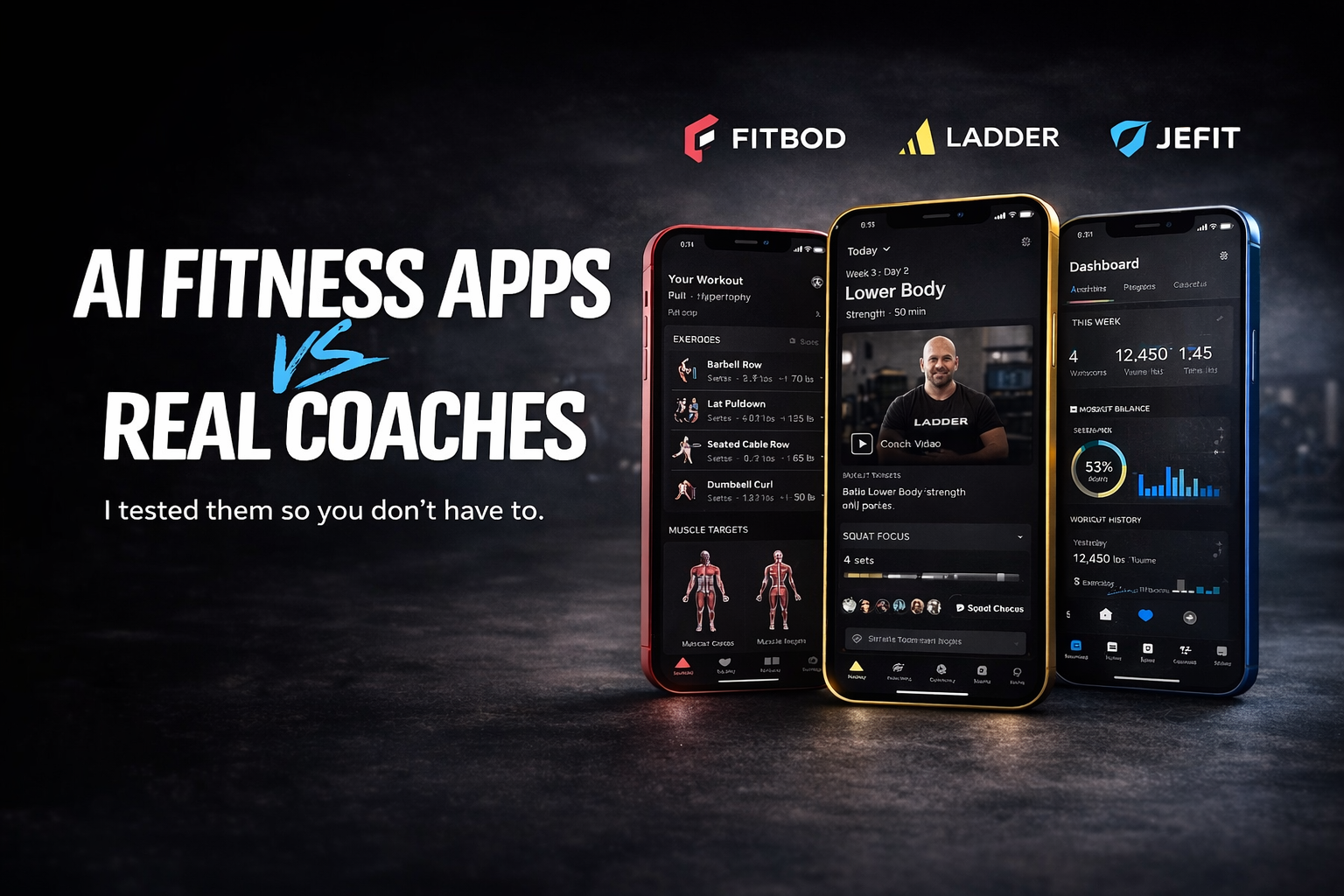
AI fitness apps like Fitbod, Ladder, and JEFIT are good at generating workouts from population data, but they cannot observe movement, manage injury grey areas, or provide real human accountability. They are segmenting the market, not replacing trainers. The trainers who thrive use AI for admin and invest the freed time in coaching.
I have spent 25 years building software products. Financial platforms, accounting tools, business systems used by thousands of Australian companies. I know what good software looks like when it ships, and I know what "works great in the demo, catches fire in production" looks like.
Full disclosure: I now build software for personal trainers (BuildStability). That gives me a perspective on this topic, and also a bias. I have tried to be fair to every app reviewed here. You can judge whether I have succeeded.
The International Fitness Academy recently published a piece asking Will AI Replace Your Job as a Personal Trainer in 2026?. Their answer was clear: no, but the profession will change. Trainers who invest in education, coaching skills, and personal branding will thrive. AI will replace average trainers, but it will amplify great ones.
I agree with that conclusion. But I wanted to test it from the product side. The IFA article covers the education and skills angle well. What it does not cover is what these apps actually do in practice, where they break, and what that means for trainers competing against them.
So I did what any product person would do. I downloaded the top three and used them.
Fitbod. Ladder. JEFIT.
The take from someone who builds software for a living, not someone selling fitness subscriptions. (App features and pricing referenced below were accurate as of March 2026. These products are actively developed and may have changed since.)
What the Apps Get Right
Credit where it is due. These apps are not bad products.
Fitbod has over 5 million downloads and a 4.8 star rating. It generates workouts based on your available equipment, muscle group fatigue, and training history. The algorithm adapts. The UX is clean. At US$16 a month, the price is fair for what you get.
Ladder takes a different approach. Real coaches build the programming, and you follow structured weekly plans. It syncs with Apple Watch, tracks your workout metrics in real time, and recently added AI-powered nutrition tracking where you photograph your meal and it calculates macros. The community layer is where Ladder really stands out: Team Chat, a post-workout selfie wall, and "cheer on" features where teammates can send you encouragement mid-workout. It was an Apple 2025 App of the Year Finalist, CNET's 2026 Best Strength Training App, and has 300,000 paid members. At US$30 a month, it is serious software built by a serious team.
JEFIT has 1,400+ exercises in its library and a free tier that gives you enough to train seriously. The community features, logging tools, and movement balance tracking are solid. Their AI progressive overload system analyses your history across all major lifts and recommends weights and reps for the next session.
If you are someone who has never trained before and cannot afford a trainer, these apps will get you moving. That is a good thing. More people exercising is better for everyone.
Disclosure: we have since built a consumer app of our own, for people who ride indoors on a smart trainer. REPley Ride puts real climbs and ERG workouts on the bike, and every ride lands in REPley next to your strength sessions, nutrition and one AI plan. It is not a strength app like the three above, so it is not part of this comparison.
But here is where the product manager in me pulls out the red pen.
The Gap: What Happens When Real Life Meets the Algorithm
I have a shoulder injury. Nothing dramatic, but enough that certain movements need modification. This is where every app started to show its limits.
Fitbod has a database of 400+ exercises categorised by joint stress. When I flagged a rotator cuff issue, it swapped overhead presses for prone Y-T-W raises. Technically correct. Gold star, algorithm. But it did not ask why my shoulder hurts, when it started, whether it is getting better or worse, or what my physio said. It accommodated. It did not assess.
JEFIT lets you mark an injury and select body parts for "light training." But its adaptation is schedule-based, not movement-based. Based on published reviews, a user with plantar fasciitis could still receive calf raises. The adaptation is based on training schedule, not on understanding the specific pathology.
Ladder's coach-built programs are better in theory. Some users have noted in app store reviews that coach messages can feel templated rather than personalised. That is a common challenge for any platform scaling coaching across hundreds of thousands of members.
To be fair, AI-powered form analysis does exist. Tempo and Peloton use cameras and sensors to correct form mid-rep. Gymscore uses computer vision that now matches elite coach accuracy for analysing lifting technique. These are real advances. But Fitbod, Ladder, and JEFIT, the three most popular consumer training apps, do not offer real-time movement correction. And even the apps that do analyse form cannot assess why a movement looks wrong, only that it does.
This is the core limitation. If your app never asks why you are modifying a movement, it is not adapting. It is accommodating. That distinction matters when someone is training around an injury and the difference between "skip this exercise" and "let's figure out what is going on" is the difference between stalling and getting better.
The US$16 App vs the $200 Coach: A Product Person's View
Twenty-five years of building products taught me something about this kind of market disruption.
Every time a cheap automated tool enters a professional services market, the same three things happen:
First, the bottom of the market gets served. People who could never afford the professional service get access to a basic version. This is good. Fitbod at US$16 a month serves people who were never going to pay $200 a month for a trainer.
Second, the middle gets squeezed. Trainers who compete primarily on workout templates, people who hand you a PDF and count your reps, lose ground. Because that is exactly what the app does, and the app does it for US$16. It also does not take a lunch break or cancel because it is raining.
Third, the top gets stronger. Professionals who deliver what the automated tool cannot become more valuable. Judgement. Individualisation. The ability to watch someone move and know something is wrong before they do. Because now every client has a frame of reference. They have used the app. They know what $16 gets them. And they are willing to pay more for the thing the app cannot do.
This pattern played out in tax preparation (TurboTax did not kill accountants, it killed the ones who just filled in forms). It played out in legal (LegalZoom did not kill lawyers, it killed the ones who just filed templates). I have watched this movie three times now. Same plot, different industry. It is playing out right now in fitness.
The AI fitness and wellness market was valued at US$9.8 billion in 2024 and is projected to reach US$46 billion by 2034 (InsightAce Analytic). That growth is real. But it is not replacing trainers. It is segmenting the market and making the good trainers more valuable.
What AI Fitness Apps Actually Cannot Do (The Real List)
After testing all three, this is the specific list of things no app handled:
Observe a movement and correct it in real time. Fitbod can tell you to do a Romanian deadlift. It cannot see that your lower back rounds at rep 6 because your hamstrings are tight today. A trainer spots that in half a second. The app spots it never.
Adjust programming based on context the client did not report. A trainer notices you walked in quiet, your warm-up was sluggish, you are not making eye contact. The session plan changes. No app sees that.
Manage the grey area of injury. "My knee feels weird" is not a data point an algorithm can process. A trainer asks three follow-up questions, watches you squat, and decides whether to push through, modify, or refer out. The app gives you a checkbox. Checkboxes do not have physio degrees.
Hold someone accountable when motivation disappears. I will give Ladder real credit here. They have thought harder about this than any other app I tested. The Team Chat creates a sense of belonging. The selfie wall makes workouts feel shared. The "cheer on" feature where teammates encourage you mid-session is a clever touch. They had me sign a nutrition commitment agreement, set streak goals, and the coaches post daily videos to the group chat. The behavioural psychology behind all of this is impressive.
But here is what happened in practice. Ladder sent me push notifications. Lots of them. And like most people in 2026, my phone groups app notifications into a daily summary that I scroll past without reading. The cheers, the streak reminders, the coach videos, they all landed in a pile with delivery updates and news alerts. There is a lot of chat and noise in the community features. For some people that energy is motivating. For me, it blurred into the background.
When my actual PT messaged me, it was a real person's name on a real text message that cut straight through to my lock screen. "Missed you Tuesday, everything ok?" That is not a notification. That is a human being who noticed I was not there. And let's not kid ourselves: he will also be charging me real money if I keep not showing up. Funny how that sharpens the commitment more than any streak badge.
Ladder's commitment frameworks and community features are smart product design, and they clearly work for hundreds of thousands of members. But they are still software creating the feeling of a relationship. A trainer is a person who actually has one with you. That difference is the second half of the equation. The habit science backs this up: tiny anchored habits work because a real coach picked the anchor and is watching, not because a streak badge fired.
Program for a specific event with a specific client. Your client signed up for HYROX Brisbane APAC on April 11. They have 9 weeks, a dodgy hip, and they are only available three days a week. An app generates a generic HYROX template. A trainer builds a plan around that person's actual life. (We wrote a whole piece on why most software fails HYROX trainers.)
47% of Australians Plan to Use AI for Fitness. This Is Your Opportunity.
This is the stat that should change how trainers think about AI apps.
According to OpenAI's own research, 47% of Australians intend to use ChatGPT for fitness and wellness by end of 2026. Already, one in three Australians use it for workout plans, meal prep, and motivation. That is not a threat. That is millions of people discovering that generic AI output is not enough for their specific situation.
Every person who uses Fitbod for three months and then plateaus is a potential client. Every person who gets a ChatGPT workout plan and then tweaks their shoulder is a potential client. Every person who pays $30 a month for Ladder and eventually hits a wall that commitment badges cannot fix is a potential client. The question is whether you spot them before they ghost you or after.
The apps are doing your marketing for you. They are teaching people what AI can do. And then those people discover what it cannot do. That is when they come looking for a trainer.
What Smart Trainers Are Doing Right Now
The IFA article makes the point that the baseline for entering the fitness industry is rising, and that education and soft skills are what separate trainers from algorithms. I agree. From the product side, I would add that the trainers growing in 2026 are also making deliberate choices about which tools they use and how. They are doing something specific:
They automate the admin AI is actually good at. Billing. Scheduling. Program templates. Client check-in reminders. If software can handle it, let software handle it, right down to GST invoices and the accounting headaches. A HYROX race plan that used to take a Sunday afternoon now takes 60 seconds. Stop spending Sunday nights building programs in spreadsheets. Your couch misses you.
They spend the freed time on what AI cannot do. Movement assessment. Behavioural coaching. Injury modification. Motivation. Relationship. The things clients actually pay $200 a month for.
They use AI connected to their client data, not generic AI. There are two categories of AI in fitness. Generic AI generates workouts from population data. Connected AI generates insights from your specific client's injury history, attendance patterns, RPE trends, and progress. Generic AI competes with you. Connected AI makes you better at your job.
They build a personal brand that an algorithm cannot replicate. Clients do not hire apps. They hire people they trust. Your reputation, your communication style, the way you show up when someone is struggling. That is your competitive advantage over every AI tool on the market, and it is the one thing that cannot be automated.
A trainer who saves 8 to 12 hours a week by automating admin and uses that time coaching has a structural advantage over a trainer who is still sending invoices manually. That is not about AI replacing anyone. That is about using the right tools. If you are weighing a switch, here is how we compare to Trainerize.
Fitbod, Ladder, and JEFIT are trademarks of their respective owners. This article is an independent review and is not affiliated with or endorsed by these companies. App features and pricing referenced were accurate as of March 2026. These products are actively developed and may have changed since publication. All app prices are in USD unless otherwise noted. Australian PT session rates are in AUD. The AI fitness market valuation is sourced from InsightAce Analytic (2024). The 47% Australian AI fitness adoption figure is sourced from OpenAI research (2025). This article does not constitute personal training or medical advice.
Frequently Asked Questions
Will AI replace personal trainers in 2026?
No. AI fitness apps serve people who cannot afford or do not want a trainer. They create demand for human coaching by teaching millions of people what AI can and cannot do. Trainers who deliver judgement, injury management, and real accountability are becoming more valuable as the market segments.
Are Fitbod and Ladder good apps?
Yes. Fitbod is strong on algorithm-driven workout generation based on over 400 million data points. Ladder offers structured coach-built programming, AI nutrition tracking, and community features with 300,000 paid members. Neither can observe movement in real time, manage injury grey areas, or provide personal accountability from a real human.
How much do AI fitness apps cost compared to a personal trainer?
JEFIT starts free, Fitbod costs US$16 a month, and Ladder costs US$30 a month. Personal training in Australia ranges from $60 to $150 per session. Apps and trainers serve different needs. A US$16 app generates workouts. A trainer manages movement, injuries, motivation, and programming as one connected system.
What can AI fitness apps not do that a trainer can?
Observe and correct movement in real time. Assess injury severity and decide whether to push through, modify, or refer out. Adjust a session based on how a client looks when they walk in. Program for a specific event with a specific person's constraints. Provide accountability that works when motivation drops.
Should personal trainers use AI tools?
Yes. Not generic consumer apps, but AI tools connected to their actual client data. Automate billing, scheduling, program generation, and check-ins. The trainers growing fastest in 2026 use AI for admin and invest the saved hours in coaching.

Matt Crofts
Matt is the founder of BuildStability, a platform that automates admin for personal trainers. He spent 25 years as a product manager building financial and business software for Australian companies. He came to the industry as a client during injury rehab, and leaves the coaching to coaches. He tested every major AI fitness app before building software to help the professionals those apps cannot replace.
Ready to automate your training business?
Start your 14-day free trial. No credit card required.
Start Free Trial