8 Fitness Trends Australian Trainers Are Not Talking About (2026 Data)
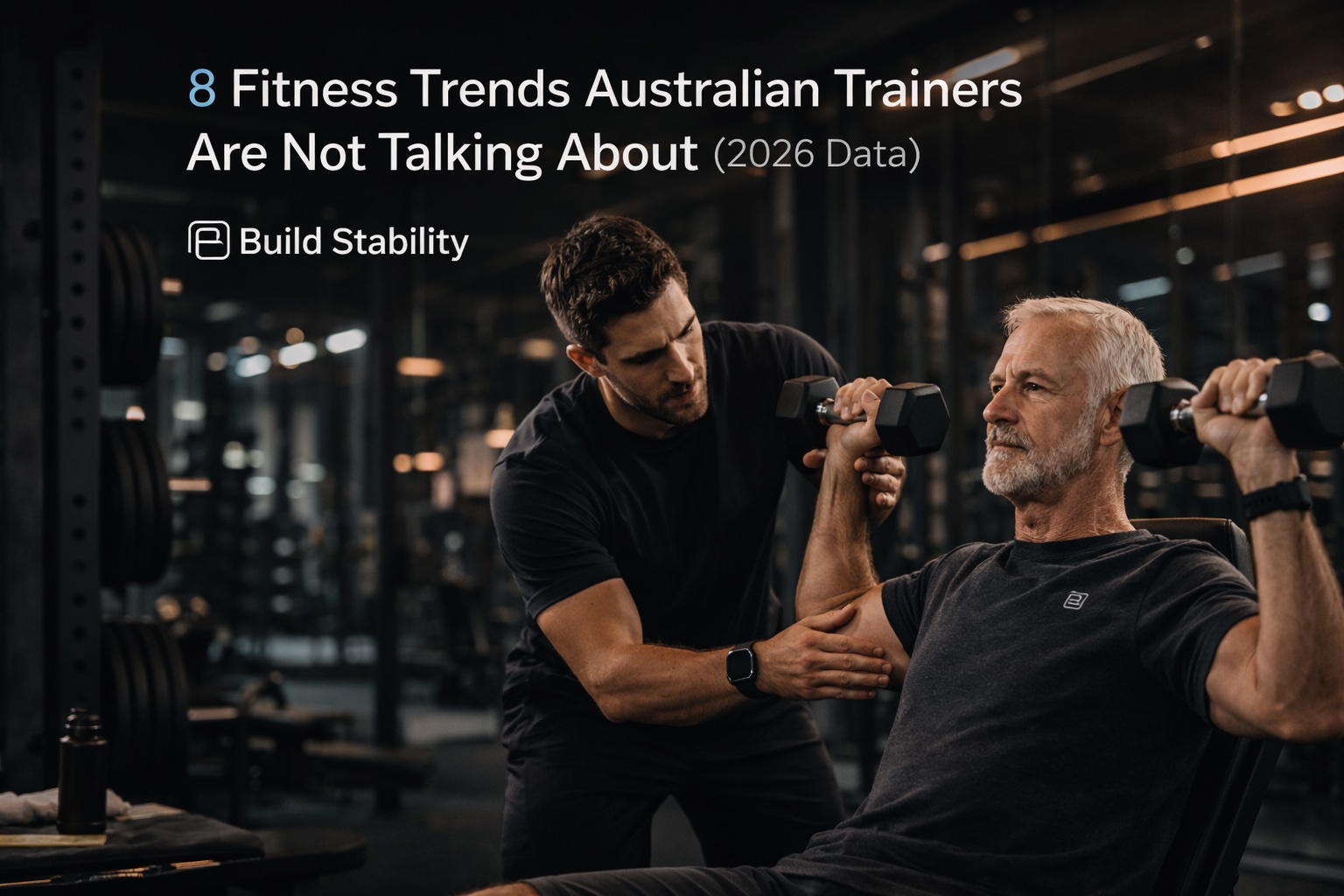
Fitness Programs for Older Adults is the #1 trend in Australia for 2026, unchanged from 2025. Pilates climbed to #2 but does not rank in the global top 20. Australia lags behind the world on fitness technology adoption, which creates a first-mover window for trainers who act now.
Ask a trainer in the US what is trending. Then ask one in Melbourne. You will get two completely different answers.
Every year, the ACSM publishes the world's largest fitness industry trends survey. Over 4,000 professionals across six continents vote on what is coming next. The global rankings get shared everywhere. What almost nobody talks about is the Australian data.
AUSactive compiled Australia-specific rankings for 2026. When you put them side by side with the global numbers, the gaps are striking. Pilates is #2 in Australia. It does not even appear in the global top 20. Mobile fitness apps are #4 worldwide. In Australia, #23. The industry your clients experience and the industry the rest of the world talks about are not the same industry.
We pulled the eight shifts that matter most if you are a PT or studio owner in Australia right now. Every stat below has a named source. If you plan your next quarter around anything, plan it around these.
Data: McAvoy CR, Batrakoulis A, Camhi SM, et al. 2026 ACSM Worldwide Fitness Trends. ACSM's Health & Fitness Journal, 29(6):16-33, 2025. Australian rankings compiled by AUSactive. Community and AI data from ABC Fitness Wellness Watch Reports, 2025.
1. Strength Training Is Back. And It Changed.
Traditional Strength Training climbed the Australian rankings in 2026. But if you are picturing bodybuilders and mirror selfies, that is not what the data describes.
The growth is in functional training. Movement quality. Longevity-focused resistance programming. Clients are not asking for bigger biceps. They are asking for programs that help them move better at 60 than they did at 50.
For your business, this means periodised strength programming is no longer a specialty. It is becoming the baseline expectation. If you already build structured, progressive plans, your addressable market just got larger. If you are doing it manually, tools like AI-driven progression engines can help you scale without spending your weekends in a spreadsheet.
2. The #1 Trend in Australia Is Not What Most Trainers Expect.
It is not HIIT. Not wearables. Not functional fitness.
Fitness Programs for Older Adults holds #1 in Australia for the second consecutive year. Unchanged from 2025.
Most trend lists get recycled and forgotten. This one does not reverse. HIIT cycles in and out. Wearables fluctuate. But the demographic shift behind longevity training is permanent. Australia's over-65 cohort is the fastest-growing segment. And unlike previous generations, they want to train, not just walk.
Here is what that means in practice. Programming for a 72-year-old is not the same as programming for a 32-year-old with lighter weights. It requires balance and mobility in every session. Fall prevention as a design principle. Functional benchmarks (Sit-to-Stand, grip strength, gait speed) tracked against published age and sex norms. Progress reports a GP can actually read.
Most PT software gives a 72-year-old the same interface as a 22-year-old. That gap is real, and trainers are starting to feel it.
3. Pilates Climbed to #2 in Australia. It Does Not Rank in the Global Top 20.
Read that again. The #2 fitness trend in this country does not even appear on the global list.
This is the single most striking divergence between Australian and world data. Reformer studio expansion. Strong female adoption across every age group. Cross-over appeal from rehabilitation through to competitive athletes.
If you run a Pilates studio, stop benchmarking against global trends. Your market is growing independently of what the US or UK are doing. This is a local story, and the data says it is accelerating.
4. The Business Model You Are Building Is Not Dying. It Is Winning.
Boutique fitness studios ranked #7 in Australia. Globally, they sit at #11. Australia is outpacing the world on this trend.
Smaller. Trainer-led. Community-focused. Built around a single modality or a curated experience.
If you have ever worried that big-box gyms and $10/week chains would eat your lunch, the data says the opposite. The studio that does one thing well, where a trainer knows every client's name, is growing faster than the industry average. The model you are building, or aspiring to build, is the one the market is choosing.
5. Your Clients Are Already Using AI. The Question Is Whether You Are.
64% of Gen Z have already used an AI fitness app. 59% of Millennials have too. Your clients are not waiting for you to decide how you feel about AI. They have already downloaded Fitbod.
But the trainers winning with AI are not using it the way clients are. They are using it to spot which clients are about to cancel. To personalise outreach at scale. To cut the admin time that eats into coaching hours.
The distinction that matters: generic AI (copying client notes into ChatGPT) loses context every session. AI connected to your actual client data (injuries, RPE trends, session history, booking patterns) carries context across every interaction. One generates a workout. The other knows your client. We tested the three biggest consumer AI fitness apps to see what they actually do and where they fall short.
Your clients are comparing what a $16/month app gives them with what you give them. That comparison is not going away. The gap between consumer apps and trainer-connected AI is where the next wave of competitive advantage sits.
The same goes for training you never see. Clients who ride indoors on a smart trainer can use REPley Ride, our indoor cycling app, and every ride lands in REPley next to the sessions you program. It is free for your clients while you use REPley, on any plan.
Source: ABC Fitness Wellness Watch Report, Q2 2025 (AI in Fitness) and Year in Review, December 2025.
6. Australia Is Behind on Fitness Tech. That Is the Opportunity.
Mobile Exercise Apps rank #4 globally. In Australia, #23.
Data-Driven Technology ranks #8 globally. In Australia, #21.
Sit with those numbers for a second. The rest of the world considers mobile fitness apps a top-five trend. Australian trainers barely register it.
This is not a criticism. It is a window. Australian trainers and studios have been slower to adopt technology than the US, UK, and parts of Asia. The trainers who move on this now, whether that is AI programming, automated billing, self-serve scheduling, or engagement tracking, will own the local conversation before competitors even start. That window will not stay open. The global data says adoption is accelerating, not slowing.
7. A Trend That Has Never Ranked in Australia Just Appeared for the First Time.
Flexible Memberships entered the Australian top 20. Pay-per-use. Credit-based access. Drop-in fees. Sliding-scale pricing. None of this ranked in previous years.
Clients want to mix and match. Try a reformer class on Tuesday, see their PT on Thursday, drop into a yoga session on Saturday. The one-size-fits-all monthly direct debit is losing ground to models that give clients more control.
If your billing only offers one option, your clients are already comparing you to studios that offer session packs, class credits, and drop-in rates. This does not mean abandoning recurring revenue. It means offering flexibility alongside it. Before you change anything, understand the real total cost of your current software stack first.
8. One in Four Adults Feel Lonely. That Changes Everything About Retention.
73% of gym members say community keeps them motivated. One in three engage with their fitness community every single day. Run clubs tripled globally in 2025.
And then there is the number that reframes everything else on this list: one in four adults say they feel lonely.
Your studio is not competing with other studios. It is competing with isolation.
The trainers who build real belonging, not a Facebook group they never post in, but genuine shared experiences, accountability, and human connection, will retain clients longer than any discount or loyalty program. If you are not sure how to spot the early warning signs before a client disengages, this guide breaks down the patterns.
Source: ABC Fitness Wellness Watch Report, Year in Review, December 2025. Run club data via Strava Year in Sport 2025, cited in ABC Fitness.
What to Do With This
These are not predictions. They are measurements from the 2026 ACSM Worldwide Fitness Trends survey (the largest annual fitness industry survey in the world, 4,000+ professionals) and the ABC Fitness Wellness Watch reports from 2025. The Australian rankings were compiled by AUSactive.
The trainers who move on these eight shifts in the next 12 months will look different from the ones who do not. Not because they worked harder. Because they read the data and acted on it.
Three things you can do this week:
1. Audit your client base by age. If more than 20% of your clients are over 50, invest in longevity programming skills now. The demand is already there, and it only grows from here.
2. Look at your billing model. If you only offer one payment option, test a session pack or credit system alongside your recurring plans. Your clients are already comparing.
3. Pick one piece of admin to automate. Scheduling, billing, or program generation. Start with whichever costs you the most hours per week. If you are still building programs in Excel on Sunday nights, that is a good place to start. And if you are ready to evaluate tools, here is our side-by-side of 7 platforms available in Australia.
Sources: McAvoy CR, Batrakoulis A, Camhi SM, Sansone J(S), Stanfield JT, Reed R. 2026 ACSM Worldwide Fitness Trends: Future Directions of the Health and Fitness Industry. ACSM's Health & Fitness Journal, 29(6):16-33, November/December 2025. DOI: 10.1249/FIT.0000000000001110. Australian data: AUSactive Top 20 Australian Fitness Trends for 2025-26. Community and AI data: ABC Fitness Wellness Watch Reports, Q2 2025 (AI in Fitness), Fall 2025 (Community in Fitness), and Year in Review December 2025.
Frequently Asked Questions
What is the number one fitness trend in Australia for 2026?
Fitness Programs for Older Adults is the #1 trend in Australia for 2026, unchanged from 2025. This is based on the ACSM Worldwide Fitness Trends survey with Australian data compiled by AUSactive. Longevity, independence, mobility, and healthy ageing are driving demand for trainers who can program for clients aged 55 and over.
Is Pilates popular in Australia compared to other countries?
Pilates ranked #2 in Australia for 2026 but does not appear in the global top 20 at all. This makes it a uniquely Australian trend, driven by reformer studio expansion, strong female adoption, and cross-over appeal from beginners to athletes.
Are boutique fitness studios growing in Australia?
Specialised fitness studios ranked #7 in Australia compared to #11 globally in 2026. Smaller, trainer-led, community-focused studios built around a single modality are growing in Australia faster than the global average.
How many people use AI fitness apps in Australia?
64% of Gen Z and 59% of Millennials have already used an AI fitness app, according to the ABC Fitness Wellness Watch Report. Trainers who use AI for admin, programming, and client retention are gaining an edge over those still relying on spreadsheets.
Is Australia behind on fitness technology?
Mobile Exercise Apps rank #4 globally but only #23 in Australia. Data-Driven Technology ranks #8 globally but #21 in Australia. This gap means Australian trainers who adopt technology now will be ahead of their local market when it catches up.
What is the flexible memberships trend in Australian fitness?
Flexible Memberships entered the Australian top 20 fitness trends for the first time in 2026. Pay-per-use, credit-based access, drop-in fees, and sliding-scale pricing are replacing one-size-fits-all monthly plans as clients want to mix and match across studios and trainers.

Matt Crofts
Founder of BuildStability. 25 years building software for Australian businesses across accounting, financial technology, and AI. CPA. A committed lifter since injury rehab introduced him to strength work, he builds tools so trainers can spend less time on admin and more time coaching.
Ready to automate your training business?
Start your 14-day free trial. No credit card required.
Start Free Trial