How to Start a Personal Training Business in Australia (2026)
If you already hold a Cert IV, you can be legally operating as a personal trainer in Australia for roughly $700 to $1,500: a free ABN, insurance averaging $31 a month, first aid currency and permits. The two rules new trainers miss most are GST registration at $75,000 turnover and council permits for park sessions.
To start a personal training business in Australia you need four things: a Certificate IV in Fitness, an ABN (free), public liability insurance (around $31 a month on average), and a plan for GST once turnover approaches $75,000 a year. If you already hold the Cert IV, you can be legally set up in under two weeks for roughly $700 to $1,500.
This guide covers every step with current 2026 costs, what is legally required versus industry-expected, and the parts new trainers most often get wrong. A word on who is writing it: I am a CPA who spent years in public practice with small businesses, including plenty in health and fitness, then 25 more building accounting software for Australian businesses. The pattern never changes. People who are excellent at the work get blindsided by the business wrapped around it. This page exists so that does not happen to you.
This is general information, not financial or legal advice. Rules and fees change (all figures checked June 2026). Confirm anything that affects your tax position with a registered tax agent.
Jump to a step:
Qualifications · AUSactive registration · ABN · Sole trader vs company · GST
Insurance · Park permits · Music licensing · Startup costs
First 10 clients · What to charge · Software · Finding an accountant · 90-day launch plan
What qualifications do you need to be a personal trainer in Australia?
You need a Certificate IV in Fitness (SIS40221) to work as a personal trainer in Australia. A Certificate III in Fitness only qualifies you as a gym-floor or group instructor working under supervision. You also need a current first aid certificate (HLTAID011, valid 3 years) and CPR (HLTAID009, renewed every 12 months).
Here is the part most guides skip: no Australian law licenses personal trainers. The Cert IV requirement is enforced by insurers, gyms, councils and industry registration instead of parliament. The practical effect is identical. Without it you cannot get insured, and without insurance you cannot contract to a gym or get a park permit.
What it costs and how long it takes:
- Certificate IV in Fitness: most courses run $1,500 to $4,500, with advertised prices across providers ranging from $1,399 to $9,805. Expect 6 to 18 months self-paced, faster if you push.
- Cert III + Cert IV bundles: $3,000 to $6,000 combined. You need 8 specified Cert III units as entry into the Cert IV anyway, so bundling is common.
- First aid and CPR: a one-day HLTAID011 course costs $100 to $195. The CPR refresher is $50 to $89 and is due every 12 months. Put the renewal date in your calendar now, because an expired CPR certificate quietly invalidates your registration and can void council permits.
A degree in exercise science or a related field also qualifies you for professional registration if university was your path instead.
Do you need AUSactive registration?
No law requires it, but AUSactive registration ($125 for 12 months, or $195 for two years) is the industry-standard credential. You need a Cert IV plus current first aid and CPR to register, and 20 continuing education credits (CECs) every two years to renew.
AUSactive is the national industry body, formerly Fitness Australia. Many gym chains ask for registration before contracting floor trainers, and some insurers price registered trainers better. If you plan to work a gym floor, treat it as part of the cost of operating. If you are building an online-only book, it is genuinely optional.
Do personal trainers need an ABN?
Yes, in practice. Almost every personal trainer in Australia operates as a contractor or sole trader, and you cannot invoice without an ABN. Registration is free at the Australian Business Register and the number is usually issued the same day. The only trainers who skip it are genuine employees paid through payroll.
The standard gym arrangement surprises people: most gyms do not employ trainers. They rent you floor access, and you run your own business on it, invoicing clients directly under your own ABN. Even if you start employed, the moment you take one private client you are carrying on an enterprise.
Two things to watch:
- Never pay for an ABN. Third-party websites charge $50 or more for a registration the government provides free. Go directly to abr.gov.au.
- Trading name: if you operate under anything other than your own name ("Southside Strength" rather than "Jane Smith"), register the business name with ASIC for about $45 a year.
Should you start as a sole trader or a company?
Start as a sole trader. It costs nothing, you lodge one tax return, and you keep the $18,200 tax-free threshold. A company pays a flat 25% from the first dollar, costs roughly $600 to register plus annual ASIC fees, and only starts making financial sense once profits clear about $120,000.
In 25 years around small business I have watched plenty of people incorporate on day one because it felt more serious. They paid for the feeling twice: setup costs immediately, then accounting fees every year after. The tax advantage of a company only arrives when your marginal personal rate climbs well past the 25% company rate, and a new PT is years from that. Stay a sole trader until a tax agent who has seen your numbers tells you otherwise.
What about a family trust? A discretionary (family) trust lets you distribute income to beneficiaries on lower marginal rates, which can make sense once your sole trader income is consistently high. The catch: the rules around what distributions are permissible have been subject to significant ATO scrutiny and regulatory tightening in recent years, particularly under Section 100A of the Income Tax Assessment Act. Arrangements that were once considered standard planning can now be challenged. Trusts also carry setup and ongoing accounting costs that do not stack up at starter income levels. File it as a future conversation with a tax specialist, not a YouTube tutorial project, and only revisit once your sole trader income regularly sits well above the top personal tax brackets.
What about superannuation? This is the one most new sole traders miss entirely. As a sole trader, no employer is paying super on your behalf. But you can make voluntary concessional contributions (pre-tax) into your own super fund and claim the full amount as a tax deduction, up to the concessional cap of $27,500 a year. At $80,000 of sole trader income, contributing $10,000 to super reduces your taxable income by $10,000, a saving most young trainers leave on the table. Starting early also gives compounding time to work. If you eventually hire staff, you are legally required to pay Superannuation Guarantee contributions on top of wages (12% of ordinary time earnings as of 2025-26). Factor that into any hiring calculation from day one.
Trust distributions and superannuation strategy are areas where the rules are complex and the ATO is active. The above is general information only. Talk to a registered tax agent about what applies to your specific situation.
Do personal trainers need to register for GST?
Only once your GST turnover reaches $75,000 in a rolling 12-month period, or you expect it to. From that point you have 21 days to register. Below the threshold, registration is optional and usually not worth it for trainers selling to consumers.
This is the rule that catches more trainers than any other, so here is the detail.
Turnover means gross income, not profit. $75,000 a year is about $1,440 a week in session income. At $80 a session, that is 18 sessions a week. A busy full-time trainer crosses the threshold without noticing.
What registration changes. You add 10% GST to your prices (the GST collected is one-eleventh of what the client pays), you claim GST credits back on business purchases like equipment, floor rent and software, and you lodge a Business Activity Statement, usually quarterly (due 28 October, 28 February, 28 April and 28 July).
The expensive mistake. Cross the threshold without registering and the ATO can treat your prices as having included GST all along. You owe one-eleventh of everything you charged, and you never collected it from anyone. I have seen this exact letter arrive. It is the third trap in our guide to the five tax traps that catch Australian PTs.
Should you register voluntarily below $75,000? Usually no. Your clients are consumers who cannot claim GST back, so registering early is a 10% price rise (or a 9% pay cut if you absorb it) in exchange for credits on your modest expenses. You are also generally locked in for 12 months. The exception is trainers with large upfront equipment spends, and that is a conversation for your accountant.
Track your rolling turnover from day one. BuildStability generates ATO-compliant GST tax invoices with your ABN automatically and keeps a BAS-ready GST report, so the threshold never sneaks up on you.
What insurance does a personal trainer need in Australia?
Two covers: public liability, for client injuries and property damage, and professional indemnity, for claims about your advice or programming. Combined personal trainer policies in Australia average about $31 a month, with most falling between $250 and $1,500 a year depending on limits.
What the market actually sells: public liability at $5 million or $20 million limits, professional indemnity from $250,000 up to $10 million. Three practical notes:
- Gyms check. A contracting gym will ask for your certificate of currency before you set foot on the floor.
- Councils set minimums. Park training permits commonly require $10 million public liability or more, so insure to that level if outdoor sessions are in your plan.
- Online trainers still need professional indemnity. No park, no barbell, but your programming advice is still the product, and PI is the cover that responds to it.
The premium is tax deductible, like most of the costs on this page.
Do you need a council permit to train clients in a park?
Usually, yes. Most Australian councils require a permit for commercial fitness training in public parks, and the rules are set locally. City of Melbourne charges about $350 a year for a personal training permit. City of Sydney parks are free, but you must register under its outdoor fitness code and carry current insurance. City of Gold Coast requires a permit, minimum $10 million public liability cover, a current first aid certificate, and a Blue Card if you train anyone under 18.
Group size caps are common too (Gold Coast caps boot camps at 18 participants). Rangers do check, and training commercially without a permit risks fines and, more expensively, an insurance claim being denied because you were operating outside permit conditions.
Related: if you regularly train under-18s anywhere, not only in parks, you need your state's Working with Children Check. In NSW it costs $107 for five years; in Queensland the Blue Card is about $105. Each state runs its own scheme, so re-apply if you move.
Do you need a music licence?
If you run your own classes with recorded music, yes: a OneMusic Australia licence, from about $259 a year for background music or $6.37 per class for instructed classes. Training one-on-one or in groups of up to eight inside a gym that holds its own licence is covered by the gym's background music licence. No music, no licence needed.
A personal Spotify or Apple Music subscription does not cover commercial use, which surprises nearly everyone. The good news: the fees are modest at PT scale, the gym carve-out covers most floor trainers, and the licence is tax deductible.
How much does it cost to start a personal training business in Australia?
Roughly $700 to $1,500 to be legally operating if you already hold a Cert IV: insurance, first aid currency, registration and permits. Add $1,500 to $4,500 for the Cert IV if you need it, and $1,000 to $5,000 for portable equipment if you train mobile or outdoors.
Here is the line-item budget I would build for a new trainer:
| Item | Typical cost (AUD, 2026) | Required? |
|---|---|---|
| Certificate IV in Fitness | $1,500 to $4,500 | Yes (if not held) |
| First aid + CPR (HLTAID011 + HLTAID009) | $200 to $285 | Yes |
| ABN | $0 | Yes |
| Public liability + professional indemnity | $250 to $600 first year | Yes (in practice) |
| AUSactive registration | $125/year | Industry-expected |
| Business name (if trading under one) | $45/year | Optional |
| Council park permit (outdoor model) | $0 to $350/year | If training in parks |
| Music licence (own classes) | $259 to $994/year | If playing music |
| Portable equipment (mobile model) | $1,000 to $5,000 | Model-dependent |
| Software (bookings, billing, programs) | $72 to $1,080/year | Strongly advised |
| Gym floor rent (contractor model) | $200 to $440/week | Model-dependent |
The model you pick moves the total more than any single line:
- Mobile, outdoor or online: about $2,000 to $7,000 all-in for year one, excluding the qualification. Lowest risk, lowest overhead, and where I would tell most people to start.
- Gym floor contractor: floor rent at the big chains runs $200 to $440 a week, which is $10,400 to $22,880 a year. At $330 a week you need 5 to 6 sessions a week at $60 before you have made a dollar. The rent buys you walk-past traffic; make sure you actually work it.
- Your own studio: $80,000 and up. Do not start here. Build the client book first.
How do you get your first 10 clients?
Referrals and proximity beat advertising at the start. Your first clients come from people who already know you train: gym-floor conversations, your own circle, one referral ask per happy client, and a Google Business Profile so locals searching "personal trainer near me" actually find you.
What this looks like in practice:
- Tell everyone, specifically. Not "I'm a PT now" but "I'm taking on 10 foundation clients at a launch rate." Scarcity and specificity convert; vague announcements do not.
- Work the floor you are renting. If you contract in a gym, the walk-past traffic is what the rent buys. Free movement assessments convert browsers into bookings better than discounts, and they do not anchor your price low the way "50% off" does.
- Set up a free Google Business Profile. Ten minutes, photos, and your first five reviews. For suburb-level searches it outperforms any paid ad a new trainer can afford.
- Partner locally. One physio who sends you post-rehab clients and one café noticeboard out-refer most Instagram strategies. Allied health referrals are also the highest-trust lead you can get.
- Ask for one introduction per client. Every happy client knows one person who has been "meaning to start." Make the ask part of your week, not a thing you do when desperate.
The maths to full-time, so you can plan honestly: at $80 a session, replacing a $75,000 salary takes about 20 sessions a week over 48 working weeks. That is 10 to 13 clients training once or twice weekly. Most trainers take 6 to 18 months to build that book, which is why starting mobile (low overhead) while keeping other income makes sense.
One more positioning note: you are not competing with a $16-a-month AI fitness app, and the data backs that up. We wrote up what AI fitness apps genuinely cannot do, and it is worth reading before you write your first sales pitch, because "accountability and adjustment" is the product clients pay trainers for.
What should you charge per session?
Self-employed personal trainers in Australia commonly charge $50 to $110 a session, and experienced trainers in Sydney and Melbourne clubs charge $80 to $150. Employed gym PTs average about $32.50 an hour, which is exactly why most go out on their own. Price backwards from your income target, not from what the trainer down the road charges.
The backwards maths, with real numbers: say you want $90,000 gross. At $90 a session that is 1,000 sessions a year, about 21 a week over 48 weeks. At $60 a session it is 31 a week, which is burnout territory. Your price is a workload decision, not a confidence decision.
Two rules from the accounting side:
- Set aside 25 to 30% of every payment for tax from day one. Sole traders get no employer withholding, and the first tax bill plus a PAYG instalment schedule arriving together has ended more small businesses than slow months ever have.
- Remember the GST cliff. Once turnover passes $75,000, 10% comes off the top of your prices (or goes on top of them). Build it into your pricing plan before you get there, not after. Salary benchmarks if you want them: SEEK lists typical PT salaries of $70,000 to $112,500 across Australian regions.
Sell packages rather than discounting singles. "10 sessions, priced for commitment" holds your rate; "$10 off this month" resets it permanently.
What software do you need from day one?
Four jobs need covering from your first paying client: bookings, payments that reconcile, GST-compliant invoices, and program delivery. You can run all four on spreadsheets and bank transfers for $0, and plenty of trainers do until the admin hours start eating their evenings. Purpose-built PT software starts at $19 a month.
The honest version of this section: at 3 clients, a spreadsheet works. The cost is not money, it is Sunday nights, and the unprofessional moments (a missed booking, an invoice with no ABN on it, a program sent as a screenshot). What to look for when you outgrow it:
- A booking link clients use themselves, so scheduling stops being a text-message thread.
- Payments that go straight to your bank account with no commission taken on top.
- Tax invoices that are actually ATO-compliant, with your ABN and GST handling built in.
- A program builder that does not live in a different app from everything else.
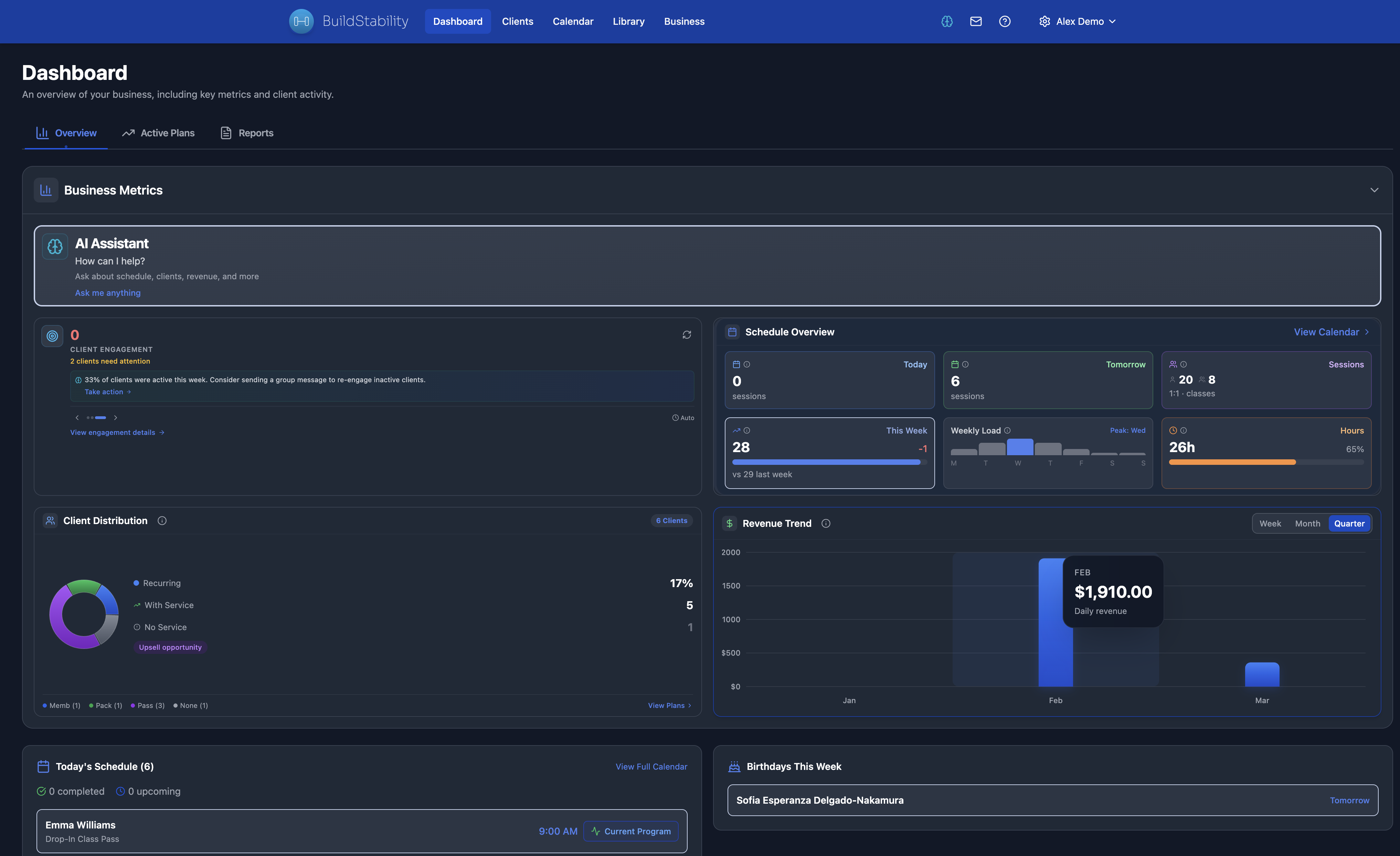
BuildStability is the Australian-built option: $19 a month for your first 6 clients with every feature included, GST tax invoices generated automatically, zero commission on client payments, and AI that drafts a periodised program in about 60 seconds for you to edit. It was built by a CPA (hello) specifically so the business side of this guide happens automatically. If you want the wider market view first, our comparison of seven PT platforms and our breakdown of what software you actually need with 5 clients are both honest about when we are not the right pick.
How do you find a good accountant for your personal training business?
Get one before your first BAS due date, not after your first tax debt arrives. A registered tax agent who understands sole traders will save more than their fee in year one through deductions alone, and they will call you as you approach the GST threshold rather than explaining it after the fact.
What is actually available, and what suits a PT:
Tax chains (H&R Block, Etax and similar) are fast and affordable for a simple personal tax return. The problem is sole trader complexity: business income, GST, BAS, deductions, depreciation and PAYG instalments are all things that chain staff handle less consistently. Staff turnover also means you rarely build a relationship with someone who knows your numbers. Fine for a simple employed year; less suited for a growing contractor book.
General small business practices are the most common fit. A boutique CPA or CA firm focused on small business will know your deductible categories cold: insurance, AUSactive fees, CPD, equipment, the business-use share of your car and phone. They will file your BAS correctly and give you advice a chain's software cannot. Look for someone who primarily works with sole traders rather than company accounts; you want your situation to feel routine to them.
PT and fitness industry specialists do exist, particularly in Sydney, Melbourne and Brisbane. Search "personal trainer accountant [your city]" or "fitness industry accountant [your city]" and you will find practitioners who have spent years with AUSactive members, know the audit triggers that catch trainers (cash income, blurring personal and business expenses, undeclared online coaching revenue) and will likely have answered every question in this guide dozens of times. Worth finding. The premium over a generalist, if any, is usually modest.
How to check before you engage:
- Verify on the Tax Practitioners Board register at tpb.gov.au. Only registered tax agents can legally give tax advice or lodge returns for a fee. CPA Australia or CA ANZ membership is a further quality filter.
- Ask specifically about sole trader experience. If they primarily do company accounts, keep looking.
- Ask how they handle communication around key dates. You want proactive contact as you approach the $75,000 GST threshold and before June 30 super contributions close, not a bill in November explaining what you missed.
- Fixed fees or clearly quoted work is a good sign. Open-ended hourly billing on routine admin is how a small sole trader becomes a large invoice.
One practical timing note: small business accountants fill up in May and June. Make contact in February or March, even if your books are still simple.
Your first 90 days: the launch plan
Ninety days is enough to go from qualified to operating with paying clients, if the order is right. Paperwork first, setup second, clients third, systems fourth.
Weeks 1 to 2: paperwork
☐ Cert IV, first aid and CPR all current
☐ ABN registered free at abr.gov.au
☐ Insurance bound, certificate of currency saved
☐ Separate business bank account opened
☐ AUSactive registration if your gym requires it
Weeks 3 to 4: setup
☐ Session price set backwards from your income target
☐ Booking link live and tested
☐ Payment method that reconciles (not cash in a drawer)
☐ Waiver and pre-exercise screening ready for every client
☐ Google Business Profile created with photos
☐ Council permit sorted if you train outdoors
Month 2: clients
☐ Launch offer announced to everyone you know, specifically
☐ One referral ask made every week
☐ Two local partnerships started (physio, sports club, café board)
☐ First 10 client conversations tracked, not just followers counted
Month 3: systems
☐ 25 to 30% of every payment set aside for tax
☐ Rolling turnover checked against the $75,000 GST threshold
☐ Pricing reviewed after your first 10 clients
☐ Tax agent booked before June, not in July
The qualification makes you a trainer. The ABN, the insurance, the pricing maths and the tax habits make you a business. Most of the trainers who fail in year one fail on the second list, and every item on it is cheaper to get right at the start than to fix after the ATO letter arrives.
If you want the business side handled while you coach, start a free 14-day BuildStability trial (no card needed) or see how the software supports a brand-new PT business from client one.
Frequently Asked Questions
Can I be a personal trainer in Australia without a Cert IV?
Legally yes, practically no. No Australian law licenses personal trainers, but insurers, gyms, councils and AUSactive all require a Certificate IV in Fitness (SIS40221) before they will cover, contract or register you. Without it you cannot get insured or rent gym floor space, which makes the Cert IV the effective minimum.
Do I need an ABN to work as a personal trainer at a gym?
Yes, if you are engaged as a contractor, which is the standard arrangement in Australian gyms. Contractors invoice the gym or their clients directly and need an ABN to do it. An ABN is free at abr.gov.au and usually issued the same day. Only PTs employed on payroll can skip it.
Do personal trainers have to charge GST?
Only once registered for GST, which becomes mandatory when GST turnover reaches $75,000 in a rolling 12-month period. You then have 21 days to register, add 10% to prices, and lodge a Business Activity Statement, usually quarterly. Below $75,000, registration is optional and usually not worthwhile for trainers selling to consumers.
How much is personal trainer insurance in Australia?
Combined public liability and professional indemnity policies for Australian personal trainers average about $31 a month based on BizCover policy data, with most policies falling between $250 and $1,500 a year. Councils commonly require $10 million public liability cover before issuing a park training permit.
Is a personal training business profitable in Australia?
It can be. Self-employed session rates commonly run $50 to $110, and experienced trainers in major-city clubs charge $80 to $150 and can earn $100,000 to $150,000 a year. About 20 sessions a week at $80 replaces a $75,000 salary. Gym floor rent of $200 to $440 a week is the biggest drag on early profit.
Do I need a council permit to train clients in a park?
Usually, yes. Most Australian councils require a permit for commercial fitness training in public parks. City of Melbourne charges about $350 a year, City of Sydney parks are free but require registration and proof of insurance, and City of Gold Coast requires a permit, $10 million public liability cover and a Blue Card if you train under-18s. Check your council before your first outdoor session.
Is personal trainer insurance tax deductible?
Yes. Insurance premiums, AUSactive registration fees, continuing education courses, music licence fees, equipment, and the business-use share of your car and phone are all deductible against personal training income. Keep receipts from day one and run business money through a separate bank account.
How much should I charge for personal training in Australia?
Common self-employed rates are $50 to $110 a session, rising to $80 to $150 for experienced trainers in Sydney and Melbourne. Price backwards from your income target rather than copying the gym down the road, and factor in the 10% GST change once your turnover passes $75,000.
Do personal trainers need to pay superannuation?
As a sole trader you are not required to pay yourself superannuation: there is no employer doing it for you. But you can make voluntary concessional contributions into your own super fund and claim them as a tax deduction, up to the $27,500 concessional cap. At $80,000 of sole trader income, contributing $10,000 to super reduces your taxable income by $10,000. If you eventually hire staff, you must pay Superannuation Guarantee contributions (12% of ordinary time earnings as of 2025-26) on top of their wages. Speak to a registered tax agent about the right contribution level for your situation.
How do I find a good accountant for my personal training business?
Look for a registered tax agent with sole trader experience. Verify on the Tax Practitioners Board register at tpb.gov.au. Tax chains handle simple returns but often struggle with BAS, GST, deductions and the sole trader complexity that comes with a growing PT book. A boutique CPA or CA practice focused on small business is usually the better fit. In major cities, PT and fitness industry specialists exist: search "personal trainer accountant [your city]". They know AUSactive, the deduction categories and the audit triggers. Book early in the year, not in July, because good small-business accountants fill up before June 30.

Matt Crofts
Founder of BuildStability. CPA who spent years in public practice, then 25 years building accounting and financial software for Australian businesses. A serious injury and the months of rehab that followed made him a convert to strength training. He builds the software that handles the business side of training and leaves the coaching to coaches.
Ready to automate your training business?
Start your 14-day free trial. No credit card required.
Start Free Trial