Your wellness budget bought column one.
Every wellness job has two columns: the part that can be written down, which is the program, the content and the reminders, and the part that needs a person in the room carrying the consequence. Apps sell the first column at scale. A company that already has an app has bought that column, and it is not the one that moves week-eight attendance. Ask a provider for week-eight attendance per cohort before you ask their price, and buy both columns.
You are about to choose a corporate wellness program, and in twelve weeks somebody will ask what it did. The number you will be handed is how many people signed up. It is the wrong number, and by the time that becomes obvious the renewal is already on the table. This guide is about buying the right number.
What a corporate wellness program usually means
Start with what firms actually run. New Zealand's 2025 employer survey, 111 enterprises covering 173,982 staff, found the large ones put an employee assistance program and flu vaccinations first, and the small ones put flexible hours first. Behind those sits the rest of the usual menu on both sides of the Tasman: a gym subsidy, a step challenge, a wellbeing app, health checks, a lunchtime class.
It is not only the big end of town, but size shows. The one Australian study to sort worksites by headcount, 218 of them in South Australia, found physical activity initiatives at 5 percent of businesses under 20 staff, 31 percent of those with 20 to 200, and 43 percent above 200. Small firms, the authors wrote, treat it as a luxury. A 40-person practice sits in the band where this starts to be normal, and where most have still not done it.
Why it is worth your time is in Gallagher's Australian wellbeing index. Its 2024 survey of 2,499 employees found people with low wellbeing had resigned in the past year at 2.5 times the rate of people with high wellbeing. Its 2025 edition put burnout above one in four and named physical health among the three biggest drivers of wellbeing. That is the case for the budget line, and it is why the physical end of the menu deserves a harder look than it gets.
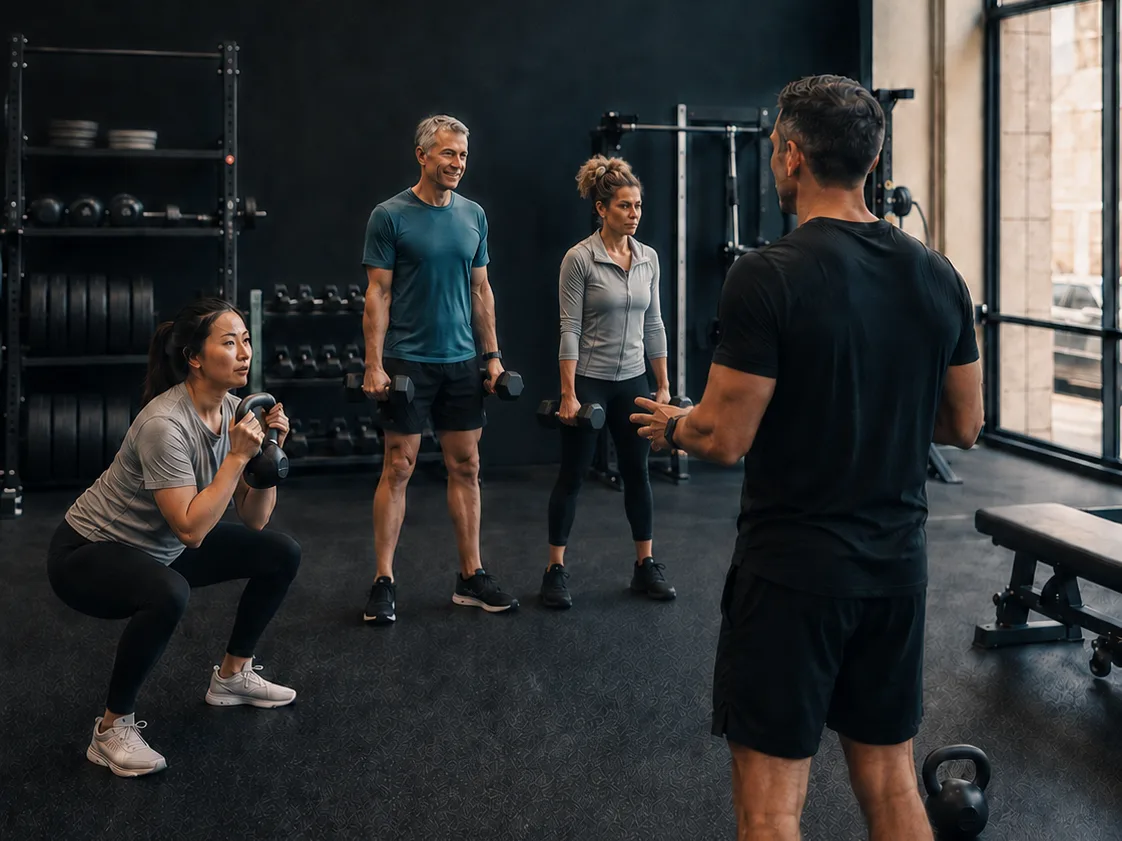
This guide is about that end: a coached strength program, in small groups, over a fixed block. It is where the evidence for mood and injury is strongest, set out below, and it is the one item where the question that decides everything applies. A flu shot has no week eight. A program people have to keep turning up for does.
The two columns
A few weeks ago a client asked me to draft a wellness tracking feature for REPley by BuildStability, the software I build. So I listed everything a corporate wellness program has to do and sorted it into two piles: the work software can do, and the work that needs a person.
The first list filled fast. The twelve-week program. The bookings and the reminders. Attendance, progress, the invoice to the company, the report at week twelve. All of it written once and delivered to two hundred people at once. That is column one, and it is what every wellness app is: column one at scale, for a subscription.
The second list was short, and everything on it had a face. The coach who notices Sam has stopped coming, and asks. The call to change today's session because three people walked in flat. The conversation that gets someone back next week. The name on the result when the number is bad. That is column two, and no app has ever sold it.
Here they are side by side, and how they fit.
| Column one: what software should do | Column two: what only a person can do |
|---|---|
| Write the twelve-week program | Adjust today's session to who walked in |
| Send the bookings and reminders | Notice who has stopped coming, and ask |
| Track attendance and progress | Have the conversation that brings them back |
| Invoice the company and draft the report | Stand behind the result at week twelve |
| Done once, delivered to everyone | Done in the room, for the people in it |
| What an app sells you | What no app has ever sold |
Column one is not there to replace column two. It is there to give it back its time. A coach on a spreadsheet at nine on Sunday night is a coach not doing column two, so the tracking, the bookings and the invoice should be automated and out of the way. That is what the feature became, and it is why this is not a case against apps. It is a question about what you bought.
When a company says "we already have a wellness app", it is naming its column. Nobody renews a program because the content was good. They renew because people were still turning up in week eight, and week eight belongs to column two.
That is what the objection usually means. Not "we do not need this" but "we bought the half nobody has to answer for, and hoped the rest would sort itself out."
Why it matters more this year
AI is being bought on the same broken number: seats, prompts, a productivity figure on a vendor slide. David Heinemeier Hansson, who created Ruby on Rails, told Lex Fridman in August that when agents got good, 37signals let its designers ship code with them. "We let them vibe." Each change looked fine alone. Together they broke the architecture, and people fixed it by hand. Column one did the work. Column two paid for it.
What AI does to the ordinary connections of an office, the question across the desk, the problem solved on the way to the kitchen, nobody knows. I think it thins them. More on that in Nobody knows what their job is anymore. Good., and the 2026 research on AI and burnout is in the companion piece.
Those connections were column two all along. Never the work, but most of what made it bearable. If the software stops needing them, something has to put them back on purpose. That is what you are buying, and a program that is only column one is the thing you already have.
Some reading this will say: two columns is a simplification. There is always a messy middle. And they could be correct, now or in the future, as AI is busy blurring the wet space between the columns. In 2025 a therapy chatbot halved depression symptoms in one trial, the heaviest ChatGPT users reported the most loneliness in another, and OpenAI had to bring back a retired chatbot's personality after users mourned it for a weekend. In July Anthropic found Claude has a small internal workspace it reasons with, a wet space of its own, then quickly added that this says nothing about AI consciousness. So one could argue the AI can notice and identify wellness in an organisation, but for now at least somebody still has to do the asking.
What a gym membership is not
The most common corporate wellness choice in Australia is a subsidised gym membership. Easy to administer, easy to explain, and not a program. It is not even column one. It is a door, and nothing behind it that knows your name.
A membership bets that the barrier was cost. For some of your staff it was, and the subsidy is well spent. For most it was never the forty dollars. It was walking into a room full of people who look like they know what they are doing, at an age where that is a bigger ask than it sounds.
Ad Coutts, a Sydney personal trainer with two decades of coaching people over 45, is building a corporate strength product on REPley by BuildStability for exactly this group. He put the distinction to me this way:
The goal is to target leadership teams in corporates, small groups, all training the same way but using the app to train at their own level, not one size fits all. It replaces the group classes they know do not work for them any more, on an individualised basis, with fitness assessments, regular check-ins, and leaderboards and metrics to keep them engaged for the full 12 weeks.
The app at their own level is column one. The coach, the assessment and the weekly check-in are column two. He sells both. As he puts it on his own page: "Not bootcamp burnout, not generic 30-day challenges: training built for how a 45+ body actually works, whether it's coming back from years off or starting completely fresh." That is column two with an experienced coach in it, and it is what a class, a step challenge or a membership cannot supply.
Why strength, specifically
Safe Work Australia counts roughly 620,000 work-related injuries and illnesses a year over the decade it measured, and puts the cost at $28.6 billion in a single year. The largest single cause of serious claims is body stressing. In an office, that is neck and shoulder pain.
Australia's national movement guidelines recommend muscle-strengthening activity on two or more days a week for every adult. 73 percent of Australians aged 18 to 64 are not doing it. The injuries that do the most damage are the ones strength training prevents best, and three-quarters of your staff are doing none. A step challenge does not touch that. A membership mostly does not either.
Three more facts, each checkable in a minute. The largest review of exercise and mental health to date, a 2023 umbrella review of 1,039 trials, found strength-based programs produced the largest drop in depressive symptoms of any exercise mode, and programs of 12 weeks or less beat longer ones. The neck and shoulder pain behind so many office claims is the injury targeted strength training has the strongest evidence for preventing and managing, and a stretching poster does not. And the dose is small: in a meta-analysis of 16 cohort studies, the mortality benefit peaked at around 30 to 60 minutes a week. You are not buying an athletic program. You are buying two short sessions inside a lunch hour with someone who knows what they are looking at.
The one number that tells you whether a corporate wellness program worked
A program that reaches two hundred staff and holds twelve in week eight did not work, whatever the enrolment report says. So before you ask a provider's price, ask one question. How many people are still attending in week eight?
Not sign-ups. Not eligible headcount. Not app downloads, the softest number in the category and the one most often shown to a board. Every one of those counts what was delivered. Week eight counts what was carried.
Providers who run good programs know the number and will tell you. Providers who sell access do not have it, because access has no week eight. For a sense of normal, a systematic review of 23 worksite health programs found participation from 10 to 64 percent, with a median of 33 percent, and that is participation at all, not week-eight attendance. A cohort holding above that median late in a block is rare.
Two things keep the number honest. Ask for it per cohort, not averaged across every client, because one keen site can carry a lot of quiet ones. And ask what they do when it drops, because it will. A provider with no answer is selling you the start of something.
Eight questions to ask a provider
None are about equipment, and most are column-two questions. A dashboard can answer the first. It cannot answer the second or the fourth.
1. What is your week-eight attendance, per cohort? Ask it first and let the answer set the tone.
2. Who is in the room, and is it the same person each week? A rotating roster of casuals cannot notice that someone has gone quiet.
3. How does one session serve the least fit person and the fittest at the same time? If everyone does the same thing, you are buying a class, and it will lose the people you most wanted to reach.
4. What happens in week three when attendance drops? You are listening for a mechanism, not enthusiasm. Your staff did not pay, so skipping costs them nothing, and something has to replace that.
5. What will my staff see about each other? Next section.
6. What do I get at week twelve, and can I see the template now? A report you have never seen gets assembled the night before.
7. What is the invoice arrangement? Monthly, on terms, with a proper tax invoice and GST shown means they have done this before. Chasing individual staff means they have not.
8. Who carries the risk if somebody gets hurt? Current public liability and professional indemnity certificates, coaching qualifications and first-aid currency, and how a participant is screened before the first session. The standard tool is the Adult Pre-Exercise Screening System, and a provider who cannot name it has not run this before. Then tell your insurer and whoever holds work health and safety that the program exists, because a session the company arranges is one it has a hand in.
What staff can see about each other
Visible competition works better in an office than anywhere else, because the participants already know each other, and it is the mechanism most likely to hold your week-eight number up.
It is also the fastest way to create a problem for you.
The answer you want is narrow. Staff see a display name the person chose, their position, their score, and whether they moved this week. Nothing else. No real names unless the person put theirs there. No weights, no body composition, no measurements, nothing from a health questionnaire. Being enrolled lists nobody. A person appears only after they choose to join and pick how they want to be known.
If a provider cannot say that cleanly, they have not thought about it, and the exposure can land on you.
Health information about your staff is sensitive information under the Privacy Act, and a wellbeing program is one of the few places a workplace ends up handling it. Employee records held by an employer sit partly outside that Act, which is narrower comfort than it sounds and does nothing for the provider: an outside coach collecting health screening is covered whatever their size. Ask where the data lives, who at the provider can open it, and what happens to it when the block ends.
What to measure at week twelve
Decide before the program starts. A measure chosen at the end is a measure chosen to flatter the result.
Attendance as a curve, not a total. A flat line at 40 percent beats a spike to 90 that ends at 10, and the total hides the difference. Ask for it as a cohort curve, never a list of names.
A short self-report, asked twice. Four or five questions at week zero and week twelve. Sleep, energy, how manageable work feels. Subjective is fine. The thing you are trying to move is partly subjective. Keep it anonymous and identical both times, report it as a cohort, and not at all below about ten responses, because an anonymous survey of eight people is not anonymous to the eight.
One qualitative round. Three sentences from the coach on what they saw, and three participants on what changed for them. This is what gets a program renewed, and it is the part nobody schedules.
Do not measure weight, body fat, or anything that turns a wellbeing program into a performance review of somebody's body. It kills participation and it puts data in your building that you do not want.
Two ground rules make the rest of it safe to hold. Taking part is voluntary and has no bearing on performance management, and people are told that in writing before the first session. And nothing comes back to a manager with a name attached. The moment individual attendance reads like a management report, you have built a new problem rather than solved an old one.
Where this leaves you
Twelve weeks from now you will be in a meeting with a number. The programs that give you an honest one are unglamorous. A consistent coach. A small group. Sessions that meet people where they are. Something that makes it normal to keep turning up. Column two, with column one underneath doing the counting.
Be clear about what this is not. Most Australian jurisdictions now regulate psychosocial hazards under work health and safety law, and the regulators are direct about it: a wellbeing program is not a control for workload, job design or bullying. Nothing here replaces that duty, and nothing here replaces an employee assistance program. A strength program sits alongside both, and it is worth saying so out loud when you take it to your board.
A coach in the room twice a week who notices when somebody stops turning up is one of the few things you can buy that helps. The eight questions will find one. Buy both columns from the same place, so the coach's roster and the report come off the same list.
If you are a coach reading this and wondering how to sell into it, the questions are your brief. Be column two. Bring column one with you. Say so plainly.
This guide is general information, not legal, tax or medical advice. Insurance, privacy and work health and safety obligations turn on your jurisdiction and your circumstances, so put the arrangement in front of your own adviser before you sign.
Corporate wellness clients for personal trainers is the companion piece to this one, written for the coach on the other side of the table. REPley by BuildStability is column one for coaches who do column two: one billing group for the company, one invoice on terms, and a board that keeps a cohort turning up. See what it costs or start a free trial.
Frequently Asked Questions
What does a corporate wellness program usually include?
In New Zealand's 2025 employer survey of 111 enterprises, large ones ranked an employee assistance program and flu vaccinations first and small ones ranked flexible hours first, with gym subsidies, step challenges, wellbeing apps, health checks and lunchtime classes behind them. Uptake rises with size: a study of 218 South Australian worksites found physical activity initiatives at 5 percent of businesses under 20 staff, 31 percent at 20 to 200, and 43 percent above 200. This guide covers one item on that menu, a coached small-group strength program over a fixed block, because it is where the evidence for mood and injury is strongest and the only item where week-eight attendance, the number that decides renewal, applies.
How do you measure whether a corporate wellness program is working?
Week-eight attendance as a percentage of the people who started, reported per cohort rather than averaged across the provider entire client base. Sign-ups, eligible headcount and app downloads all measure access rather than participation, and a program can score well on every one of them while nobody is attending. Pair the attendance curve with a short anonymous self-report asked identically at week zero and week twelve.
Is a subsidised gym membership a corporate wellness program?
It is a benefit rather than a program. A membership assumes the barrier was cost, which is true for some staff and not for most, and it transfers the whole problem of turning up to the individual. It is easy to administer and easy to explain, which is why it is the most common corporate wellness line item in Australia, but it produces no participation data and no accountability.
We already have a wellness app. Do we still need a corporate wellness program?
An app covers the half of the job that can be written down: the program, the content, the assessment, the reminder. That half should be automated and out of the way. It does not cover the half that needs a person in the room, noticing who stopped turning up in week three and doing something about it, and that is the half a program is judged on. If the numbers the app reports are downloads and logins rather than week-eight attendance, you have bought the first half. A good program adds the second, and the best ones run on an app underneath so both halves share one roster and one report.
What can staff see about each other in a workplace fitness challenge?
In a well-built program, only a display name the person chose, their position, their score and whether they moved this week. No real names unless the participant used theirs, no weights, no body composition, no measurements and nothing from a health questionnaire. Enrolling somebody should not list them either: a person should appear only after they choose to join.
What should you ask a corporate wellness provider before signing?
Week-eight attendance per cohort, whether the same coach attends every session, how one session accommodates the least fit and the fittest person at once, what happens when attendance drops in week three, what staff can see about each other, whether you can see a blank copy of the week-twelve report during the pitch, whether they can invoice the company monthly on terms with GST shown, and what insurance, coaching qualifications and pre-exercise screening they carry.
How long should a corporate wellness program run?
Long enough to pass the point where programs normally collapse, which is weeks three to eight. A block of eight to twelve weeks with a defined start and end gives you a measurable result and a natural renewal conversation. Open-ended arrangements make the participation drop invisible because there is never a moment where somebody has to report on it.
Does a company pay fringe benefits tax on a corporate wellness program?
It depends on how the benefit is delivered, and it is a question for your accountant rather than your provider. Work-related counselling and some health programs have specific treatment, while a general gym membership provided to staff is commonly treated differently again. Ask before you structure the arrangement, because the tax treatment follows the structure, not the intention.

Matt Crofts
Founder of REPley by BuildStability. 25 years building software for Australian and New Zealand businesses across accounting, financial technology and early AI work. CPA, formerly in public practice advising sole traders. He came to strength training through months of physio after a serious injury, and it has been part of his life since. He builds the tools that handle the business side of coaching and leaves the coaching to coaches.
Ready to automate your training business?
Start your 14-day free trial. No credit card required.
Start Free Trial