Corporate Wellness Clients for Personal Trainers (2026)
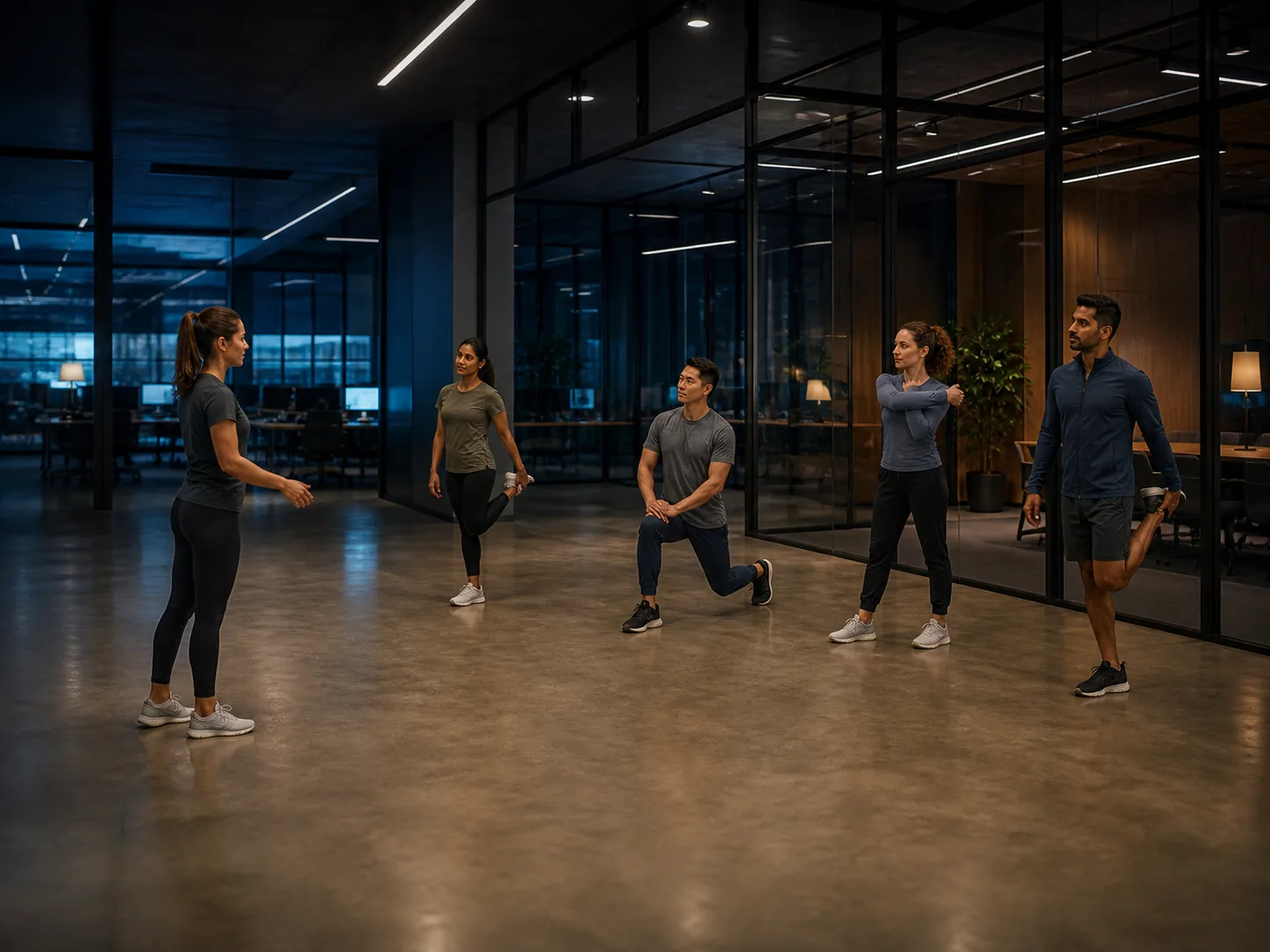
The 2026 research splits two ways: AI lowers burnout when it removes drudgery and raises it when you have to supervise it, and the thing it reliably erodes is human contact. Employers in Australia and New Zealand carry a legal duty to manage psychosocial risk, can now measure the damage precisely, and have nobody inside the building who can repair it. That is the opening for coaches.
Twenty-five years in software, the last few as founder and CEO of REPley by BuildStability, and this is the strangest stretch of it. Agents now take a real share of the routine work around me: first drafts, boilerplate, the first pass on a support ticket. Everything still gets reviewed by the team, as shipping software to businesses always has. The gain is real and I would not give it back.
The other thing is harder to put on a slide. Agents produce more than anyone can read, so another agent is set to interpret the first, and the people drift to the edge of the loop, reviewing what comes out. What that does to the ordinary connections of an office, the question across the desk, the problem solved on the way to the kitchen, nobody knows yet. I think it thins them, and it is worth watching.
If you work in an office you can probably feel it already. You are busier than you have ever been, and you would struggle to name one conversation this week that was not about a task.
If you coach the people in those offices, that feeling is your next few years of new business. It is why corporate wellness clients for personal trainers are getting easier to win than at any point in the last decade.
Why corporate wellness clients are the biggest new opportunity for personal trainers
Companies have spent three years buying instruments that detect their own damage. Engagement dashboards, focus-time reports, wellbeing pulse surveys, sentiment analysis on internal chat. The measurement layer is good now. A 300-person firm can tell you which team's calendar fragmented in March and which one stopped taking annual leave.
None of it repairs a person.
A dashboard can name the problem. It cannot do the reps, cannot hold someone accountable on a Tuesday morning in July, and cannot rebuild a body that has been sitting for eleven hours a day for two years. That work is done by humans who do not work for the company. Physios, psychologists, GPs and coaches.
Here is the rule underneath it. Split any job into two columns. Column one is the part that can be written down: the program, the content, the assessment, the reminder. Column two is the part that needs a person in the room, making a call and carrying the consequence. Automation takes column one, and every hour it takes raises the price of every hour left in column two. Businesses across Australia and New Zealand are automating the measurable middle of their operations and discovering that what is left is the part only a person can do.
You are column two. That is not a threat to your industry. It is a purchase order pointed at it.
It also explains the objection you will hear most often, which is "we already have a wellness app." Every wellness app is column one at scale for a subscription fee, and I say that as someone who builds one. When a company tells you it has an app, it is telling you which column it bought, and it has bought the one that does not move the number it is measured on. Nobody renews a program because the content was good. They renew because people were still turning up in week eight, and that is your column.
What the 2026 research actually says about AI and burnout
The honest version is the one to quote in a pitch, because someone in the room will have read it.
AI is not uniformly burning people out. It splits.
Harvard Business Review published a study of 1,488 full-time workers in March 2026 naming a pattern the authors call AI brain fry: mental fog, slower decisions and headaches from supervising AI beyond your cognitive capacity. Workers reporting it had 33% more decision fatigue. Those constantly checking AI output spent 14% more mental effort and reported 19% more information overload. Running three AI tools at once wiped out the productivity gain entirely. In the same study, workers who used AI to offload repetitive tasks got less stressed, not more.
Workday research released in May 2026, covering 2,150 employees across seven countries at large AI-using organisations, found 62% said their stress or burnout risk had gone down since they started using AI and 86% felt more productive.
Set that against the aggregate picture. Gallup's State of the Global Workplace 2026 put global engagement at 20% in 2025, the lowest since 2020, with manager engagement at 22%, down nine points since 2022. Microsoft's Breaking down the infinite workday counted the average worker being interrupted every two minutes, 275 times a day, across 117 emails and 153 Teams messages.
AI removes drudgery and adds supervision, and the net depends on how a company implemented it. Every one of them can now measure which side of that line they landed on.
Knowing has repaired nobody, because the repair is physical and there is nothing inside a company that can do it.
The thing AI removes that nobody put in the budget
The Workday numbers contain the part that should interest you most, and it is not the burnout figure.
A third of employees, 33%, rarely or never have a conversation with a colleague that goes beyond transactional work. Fewer than half, 46%, find it easy to make friends at work. Fourteen per cent have taken time off because of loneliness or isolation, rising to 20% of Gen Z. Asked what worries them about AI, 43% named reduced human-to-human interaction ahead of everything else.
Automation traded workload for contact. Companies measured the workload side because that was the business case. Nobody costed the other side.
A standing weekly appointment with a person who knows your name, notices you are flat, and expects you on Thursday is not a wellness perk. In an organisation where a third of people have stopped talking to each other, it is the only structured human contact some of those staff will have all week.
That is what you are selling. Price it accordingly.
In Australia and New Zealand, this is a legal duty
Most trainers pitching corporate work get this part wrong, and it is the difference between an email that gets deleted and one that gets forwarded.
Employers are not buying wellbeing because it is nice.
In Australia, amendments to the model Work Health and Safety Regulations covering psychosocial risk commenced on 1 April 2023 and have been adopted across most jurisdictions, with Victoria bringing in its own psychosocial regulations in December 2025. The hazard list reads like the Microsoft report: high job demands, low job control, poor support, sustained pressure. Safe Work Australia publishes a model Code of Practice on managing them, and a code of practice is admissible in proceedings as evidence of what was reasonably practicable at the time. It is a standard every business owner is held to, founders and CEOs included, and it keeps moving.
In New Zealand, the Health and Safety at Work Act 2015 defines health as both physical and mental, so the duty to eliminate or minimise risk so far as is reasonably practicable already covers psychological harm. WorkSafe has since published good-practice guidance on managing psychosocial risks at work, which does not create new obligations but does set out what a regulator expects a PCBU to be doing about them.
The measured problem is on both sides of the Tasman. Beyond Blue found in a nationally representative survey of 1,000 Australians in June 2025 that one in two workers had experienced burnout in the past year, with 18 to 29 year olds worst affected and half of those affected never seeking support. The Productivity Commission put the total cost of mental ill-health and suicide to Australia at $200 billion to $220 billion a year. In New Zealand, the 2026 Umbrella and Geneva wellbeing report surveyed 11,610 working New Zealanders and found high workload, poor change processes and low psychological safety significantly raise the risk of psychological distress and ill health.
A legal duty to control the hazard, a measured problem, and nobody inside the building who can do the work. That is the pitch, and you did not have to write a word of it.
General information, not legal or tax advice. WHS duties and tax treatment differ by jurisdiction and change over time (checked July 2026). Point the company at their own adviser for what applies to them.
What the evidence says about exercise and burnout, honestly
If you are selling into a duty-of-care conversation, get the claim right, because someone in that meeting will check it.
The strongest evidence is for depression and anxiety, not for burnout. A 2023 University of South Australia umbrella review in the British Journal of Sports Medicine pooled 97 reviews, 1,039 trials and 128,119 participants. Its own wording is that the effect of physical activity on depression and anxiety is "comparable to or slightly greater than" psychotherapy and medication. You will see it quoted as 1.5 times more effective; that figure comes from the university's press release, not the paper, and the person across the table may know that. Use the paper's words.
Two findings in the same paper matter more for your pitch. Every mode helped, and strength-based programs produced the largest reduction in depressive symptoms of any of them: a median effect size of 0.64, against 0.45 for aerobic exercise and 0.46 for yoga and stretching. And shorter programs did better, with blocks of 12 weeks or less showing roughly three times the effect of programs running 24 weeks or more.
Short blocks work best. Short blocks are also what a manager can approve without a budget round. That is a rare case of the clinical answer and the commercial answer agreeing.
Now the caveat, and say it before anyone else does. The Umbrella data from 11,610 New Zealanders points the other way on causation: psychosocial risk factors in how the work is designed drive outcomes more than personal health behaviours do. Reviews looking specifically at occupational burnout report inconsistent results. Exercise is not a cure for a badly designed job.
That is not a weakness in your offer. It is the honest frame. You are the control measure that repairs capacity while they fix the workload, and a proposal that says so will be the only one on the desk that does not oversell. The trainers who promise to fix burnout are the reason procurement is cynical about this category.
Why strength training, not a step challenge
Most corporate wellness spend that touches the body buys steps, a gym card or a lunchtime yoga class. None is wrong. None has the strongest evidence behind it either, and the difference is worth knowing before you write a proposal.
The guideline already says it. Australia's 24-Hour Movement Guidelines for adults, updated in 2026, recommend muscle-strengthening activity on two or more days a week, graded as a strong recommendation. The same line applies to adults over 65. It is not a niche prescription. It is the national baseline.
Almost nobody is doing it. The ABS National Health Survey found 73 percent of Australians aged 18 to 64 did not do two days a week of muscle-strengthening activity, 76 percent of women and 71 percent of men. Over 65 it is 84 percent. A company's staff are, on those numbers, three-quarters non-compliant with a guideline their own government publishes, which is a more useful opening line than anything about engagement.
The dose is small. A 2022 meta-analysis of 16 cohort studies in the British Journal of Sports Medicine found muscle-strengthening activity associated with a 10 to 17 percent lower risk of all-cause mortality, cardiovascular disease, cancer and diabetes, with the largest benefit at roughly 30 to 60 minutes a week. The authors call the effect of much higher volumes unclear. Say that plainly rather than inventing a cliff. The point for a corporate block is that two coached sessions a week sits inside the range where the evidence is strongest.
It moves the number HR cares about. A meta-analysis of 33 randomised trials in JAMA Psychiatry found resistance training reduced depressive symptoms with a moderate effect and a number needed to treat of four, and the effect did not depend on how much was prescribed or whether the person got measurably stronger. Four people in a program for one to feel meaningfully better is a figure a CFO can do something with.
It fixes the injury they are already paying for. Body stressing is the single largest cause of serious workers' compensation claims in Australia, and neck and shoulder pain is the office worker's version of it. In a Danish trial of employed women with chronic neck pain, ten weeks of specific strength training cut worst-case pain by around 79 percent, while general fitness training on a bike produced only a brief dip. A later trial found as little as two minutes a day of targeted resistance work reduced neck and shoulder pain in office staff. Specific beats general, which is an argument for a coach and against a step counter.
It is the one thing an ageing workforce loses fastest. Muscle mass declines through midlife, and strength declines two to five times faster than mass does, according to a quantitative review of the ageing literature. Australians aged 55 to 64 are in the workforce at a record rate. A Cochrane review of 121 trials found progressive resistance training in adults over 60 produced large strength gains and measurable improvements in day-to-day function. The 52-year-old who has quietly stopped using the stairs is exactly the person a general class loses and a coached strength block keeps.
None of this says strength training fixes burnout. The section above is clear on that. It says that if a company is going to fund physical activity at all, the mode with the strongest evidence, the smallest effective dose and the clearest link to the injuries they already pay for is the one most wellness programs leave out.
The FBT question their accountant will ask before they say yes
This is where a proposal gets approved or quietly parked, and almost no trainer knows it exists.
In plain terms: when a business pays for something personal for its staff, the tax office can treat it as a perk and tax the employer on the value of it. Australia and New Zealand both call that fringe benefits tax. You never pay it and it is not your problem to solve. It is the employer's cost, sitting on top of your fee, and it is the first thing their accountant will check. That is why it decides whether the answer is yes.
The Australian shape, in three lines:
- A gym on their own premises is generally exempt. A recreational facility located on the employer's business premises is an exempt benefit under section 47(2) of the FBT Assessment Act.
- Buying staff memberships at an outside gym generally is not. That is treated as recreational entertainment and generally attracts FBT.
- The small-benefit escape hatch usually does not help. The minor benefits exemption reaches benefits worth under $300 that are also infrequent and irregular. A 12-month membership is neither.
Then the trap, and this one is about you specifically.
A company with a gym on site will reasonably assume the exemption covers whatever happens in that room. It does not. In ATO ID 2015/25 the ATO considered an employer whose premises included a room with gym equipment and open floor space, and who engaged an instructor to run a weekly class for staff in it. The published view was that the section 47(2) exemption did not apply, because what the employee received was participation in a class, not the use of the facility. The room was a recreational facility. The class was a different thing.
Two qualifications on that, both worth knowing. It is dated September 2015 and the ATO last reviewed it in April 2026, so it has not been quietly retired. It is also an interpretative decision, which the ATO publishes as an edited record of a decision rather than as advice, so it shows you the shape of the issue and not the answer for any particular business.
New Zealand runs the same idea with different numbers. Gym subsidies are a classic unclassified fringe benefit, exempt under the de minimis rule up to $300 per employee per quarter and $22,500 across all staff per year. Cross the quarterly limit and the excess is taxed. Cross the annual one and all of it is.
None of this is yours to answer, and you should not try. Put one line in the proposal, in these words or close to them: the FBT treatment will depend on how the arrangement is structured, and your accountant should confirm it before you sign. Then stop talking about tax and go back to talking about training.
That sentence costs you nothing. It also puts you ahead of every other proposal on the desk, because the others are a price list and a photo of a kettlebell.
How to package corporate wellness for a small PT business
Four offers cover almost every business under 500 staff. Pick one, not four.
A 12-week onsite block. Two 45-minute small-group sessions a week, capped at eight, invoiced to the business as a single block. Start date, end date, report at the end. The fixed length is a feature. It matches the evidence and lets a manager approve it without owning it forever.
Subsidised 1:1. The business contributes a fixed amount per person per month and the staff member pays the rest. The employer's risk drops, your retention rises, and the staff member has skin in the game, which is what predicts whether they turn up.
A screening and movement audit. Paid, one-off, half a day on site. This is the door opener, and it gives you the data for the next proposal.
A 90-day onboarding for new starters. Structured, milestone-based, and it lands inside an existing HR process instead of asking them to build a new one.
Where to start: professional services. Accounting and law practices are the clearest early market in both countries. AI has taken more measurable work out of compliance than out of almost any other profession, what is left is judgement and client contact, and the crunch is a scheduled event you can plan a block around. Australian practices are wrecked in the run to 30 June and the BAS quarters. New Zealand practices have the 31 March balance date and the tax-return season behind it. Pitch a 12-week block that finishes before the crunch, not one that starts during it.
Who to send it to: whoever owns WHS or people and culture. In a business under 200 staff that is often the operations manager. Not the CEO.
What to write: their language, not yours. Psychosocial risk, control measure, reasonably practicable, participation rate. A proposal opening with transformation photos gets filed. One opening with a control measure, a 12-week evaluation and an FBT note gets a meeting.
How to price it: off your existing group rate and 1:1 rate. Session rate, multiplied by sessions in the block, plus a loading for travel, reporting and the fact that a business pays on 30-day terms instead of up front. Quote the block as one number with GST shown separately, 10% in Australia and 15% in New Zealand. A per-head figure invites a negotiation about headcount, and you will lose it.
The detail that kills these deals is cash, not coaching. A business pays on invoice with terms. If you cannot survive 30 days between the work and the money, fix that before you send the proposal. Our guide to starting a personal training business in Australia covers the ABN, GST and invoicing side.
What corporate work demands from your software
You will not win a corporate contract on column two alone. HR needs column one to exist as well: a roster, an invoice, a report, and a reason for people to turn up between sessions. Bring it with you, or the meeting ends at "who does the admin."
Corporate clients break most PT software in the same place. The payer and the participant are different people, and this category was built on the assumption that they are the same person.
Five things have to work.
- One client record per staff member. Standard in every product, ours included.
- Group scheduling with caps and a waitlist, because onsite sessions are capacity-limited and someone always drops out on the day. REPley by BuildStability handles this through classes, with a capacity limit, a waitlist and automatic promotion when a spot frees up.
- Attendance and engagement data you can turn into a report at week 12. The company will ask what it bought, and turning up with a spreadsheet you built on a Sunday is how a renewal quietly dies. We track attendance and an engagement score per client, built to flag someone drifting 30 days before they quit, which is exactly what a corporate sponsor is paying you to manage.
- Something that makes staff turn up in week eight. Attendance data tells you participation collapsed. It does not stop it. Challenges are the piece that does: one thing that counts, a fixed length, and a board built straight from the billing group you already invoice.
- One invoice to the business covering fifteen people, on terms. Create the company as a billing group in REPley, add the staff, and one invoice goes to the business with a line per person, on 30-day terms, GST handled from your tax setup, with the company's ABN on it. The Billing tab shows what is outstanding and overdue, a reminder is one tap, and each period's invoice drafts itself from the current member list for you to review and send. The first invoice of any group, and any invoice whose amount changed because someone joined or left, always crosses your desk before it goes anywhere. Corporate billing is only trustworthy with a human in the loop at exactly those moments, so that is how it is built.
Families use the same group machinery with a different payer: a parent puts their card on file once, it auto-charges each week or month, and every family member's sessions top up on their own. Corporate blocks are the seasonal income; family memberships are the recurring one. Both take about two minutes to set up.
Week three is when a corporate wellness program quietly dies
Week one is easy. Fourteen people book in, HR forwards the email around, someone posts a photo in the team channel.
By week three, four people show up. By week eight it is the same two who were already training before you arrived.
Nothing went wrong with the coaching. Nobody decided to stop. It drifted, the way things do when no one is watching, and the company arrives at the renewal conversation having quietly concluded it did not work.
This catches out trainers coming from one-to-one work. Your individual clients pay for their own sessions, so the money does the nagging for you. In a corporate block the person in the room did not pay and feels no cost when they skip. The accountability that normally rides in on the invoice is missing, and something has to take its place.
A leaderboard does that better in a workplace than anywhere else, for one reason that has nothing to do with software: they already know each other. A staff cohort will see each other at the coffee machine on Thursday. That is a different animal from a stranger on a fitness app.
Pick one thing that counts, and only one, because a board somebody can explain to a colleague in a single sentence is a board they keep opening. Workouts completed. Class check-ins. Habits ticked. Total weight lifted. Then a length: two, four, six or twelve weeks, so it finishes inside the block the company paid for.
The roster is the part that gives you an evening back. You already built that company as a billing group to invoice it. The same group seeds the challenge, so the staff list becomes the board without you typing a single name.
The question HR asks first
Whatever you put in front of a company, someone in that meeting asks what staff can see about each other. Have the answer ready, because a vague one ends the conversation there.
Staff see a display name the person chose, their position, their score, and whether they moved this week. That is the entire list. No real names on the board, no weights, no body composition, nothing from a health questionnaire. Being invited does not put anyone on it either. A person appears only after they tap to join and pick the name they want to be known by. You see real names on your own screen, because you are their coach. Nobody else does.
That answer carries more weight in a corporate pitch than any feature you could describe. HR is not sitting there judging your programming. They are working out whether you are about to become their problem.
What a board will not do is make an unwilling person train. It gives the willing ones a reason to keep turning up in week eight, and it hands you something to show the sponsor that is more interesting than an attendance percentage.
The part AI cannot do
I wrote last year that AI agents were collapsing the software pipeline and exposing what was underneath it. Every role split into its column one, which AI absorbed, and its column two, which got more valuable.
The same split is running through every industry that automates, and the 2026 data shows where it lands. AI writes the program. It tracks the numbers, spots the trend and drafts the message. REPley does all of that inside our product, and I built it to, because column one should be cheap and a coach doing it by hand on a Sunday is a coach not doing column two. It does not get someone off the couch in week three when motivation is gone, and it does not have a conversation with a person who has not had one in a fortnight. We went through this in detail in AI fitness apps versus personal trainers and the answer has not moved.
Companies have bought column one and called it wellness. They will keep buying better instruments for a while yet. Eventually someone in that meeting asks what the instruments have actually fixed, and the answer sends them looking for a person.
Be findable when they do.
Corporate blocks are a scheduling, billing and participation problem long before they are a coaching problem. That is column one, and REPley by BuildStability handles it: the class caps, the attendance data, the company invoice on terms, and the board that keeps staff turning up in week eight, all off the one billing group. See what it costs or start a free trial.
Frequently Asked Questions
What is corporate wellness for personal trainers?
Coaching sold to a business rather than to an individual. The company is the payer, the staff are the clients, and the deliverable is usually a fixed-length block of small-group training, subsidised 1:1 sessions, or a screening and movement audit. The commercial difference from normal PT work is that you invoice a business on terms instead of charging a card at the door.
How do personal trainers get corporate clients in Australia and New Zealand?
Start with the person who owns work health and safety or people and culture, not the CEO. In a business under 200 staff that is often the operations manager. Lead with their duty language from the WHS Regulations in Australia or the Health and Safety at Work Act 2015 in New Zealand, offer one paid pilot with a start and end date, and bring a report at the end showing attendance and self-reported change.
Do Australian and New Zealand employers legally have to look after employee mental health?
Both countries treat psychological health as part of the health and safety duty. Australian amendments to the model WHS Regulations covering psychosocial risk commenced on 1 April 2023 and have been adopted across most jurisdictions, with Victoria introducing its own psychosocial regulations in December 2025. New Zealand law defines health under the Health and Safety at Work Act 2015 as both physical and mental, and WorkSafe has since published good-practice guidance on managing psychosocial risks. In both, the duty is to eliminate or minimise the risk so far as is reasonably practicable. Neither requires an employer to buy anyone a gym membership.
Does exercise actually fix burnout?
The evidence is strong for depression and anxiety and weaker for burnout as a workplace syndrome. A 2023 University of South Australia umbrella review in the British Journal of Sports Medicine, covering 97 reviews and 128,119 participants, found physical activity around 1.5 times more effective than counselling or the leading medications for symptoms of depression and anxiety, with programs of 12 weeks or shorter working best. The 2026 Umbrella and Geneva wellbeing report, drawn from 11,610 working New Zealanders, found psychosocial risks such as high workload and low psychological safety drive wellbeing outcomes more than personal health behaviours do. Sell the mechanism you can defend, not a cure.
Does a company pay fringe benefits tax on staff fitness programs?
It depends on how the arrangement is structured, and it is the first thing their accountant checks. In Australia a recreational facility on the employer premises is an exempt benefit under section 47(2) of the FBT Assessment Act, while paying for memberships at an outside gym is generally recreational entertainment that attracts FBT, and the minor benefits exemption only reaches benefits under $300 that are also infrequent and irregular. ATO ID 2015/25, published in October 2015 and last reviewed by the ATO in April 2026, sets out the view that participation in a fitness class run on business premises is not covered by the section 47(2) exemption, because the benefit received is the class rather than the use of the facility. In New Zealand, gym subsidies are an unclassified fringe benefit with a de minimis of $300 per employee per quarter and $22,500 across all staff per year. A trainer should raise the question in the proposal and leave the answer to the business and its accountant.
What should a personal trainer charge a company for a wellness program?
Price off your existing group and 1:1 rates rather than inventing a corporate rate. Take your small-group session rate, multiply by the number of sessions in the block, add a loading for the site visit, the reporting and the fact that a business pays on 30-day terms rather than up front. Quote the block as one number with GST shown separately, 10% in Australia and 15% in New Zealand, not a per-head figure that invites the company to negotiate headcount.
Is AI reducing the need for personal trainers?
The opposite is happening in the corporate market. Workday research published in May 2026 found 62% of employees at AI-using organisations said their burnout risk had fallen, and in the same survey 33% rarely or never had a conversation with a colleague beyond transactional work and 43% named reduced human interaction as their top concern about AI. Automation is trading workload for contact, and contact is what coaching sells. REPley by BuildStability is built on that split: REPley writes the periodised program and the progress summary, and the coach does the coaching.
How do you keep staff engaged in a corporate wellness program?
Participation is what kills most corporate blocks, not programming: week one fills and week three empties, because the person training did not pay and feels no cost when they skip. A challenge with one metric and a fixed length of two to twelve weeks replaces that missing accountability, and it works better in a workplace than in a public app because colleagues already know each other. In REPley by BuildStability the board is seeded from the billing group you invoice, and staff appear under a display name they chose rather than their real name, with no weights or health data shown to anyone.
What software do you need to run corporate wellness clients?
Anything that separates the payer from the participant. You need one client record per staff member, group scheduling with caps and a waitlist, attendance data you can turn into a report at week 12, and one invoice to the business on terms. REPley by BuildStability covers all four: class capacity with waitlist promotion, an engagement score per client, and billing groups that let a company pay for its staff on one invoice with 30-day terms, a line per person, and each member's sessions ready before the invoice is even paid. Recurring periods can draft their own invoice for you to review, and overdue ones get a one-tap reminder.

Matt Crofts
Founder of REPley by BuildStability. 25 years building software for Australian and New Zealand businesses across accounting, financial technology and early AI work. CPA, formerly in public practice advising sole traders. He came to strength training through months of physio after a serious injury, and it has been part of his life since. He builds the tools that handle the business side of coaching and leaves the coaching to coaches.
Ready to automate your training business?
Start your 14-day free trial. No credit card required.
Start Free Trial